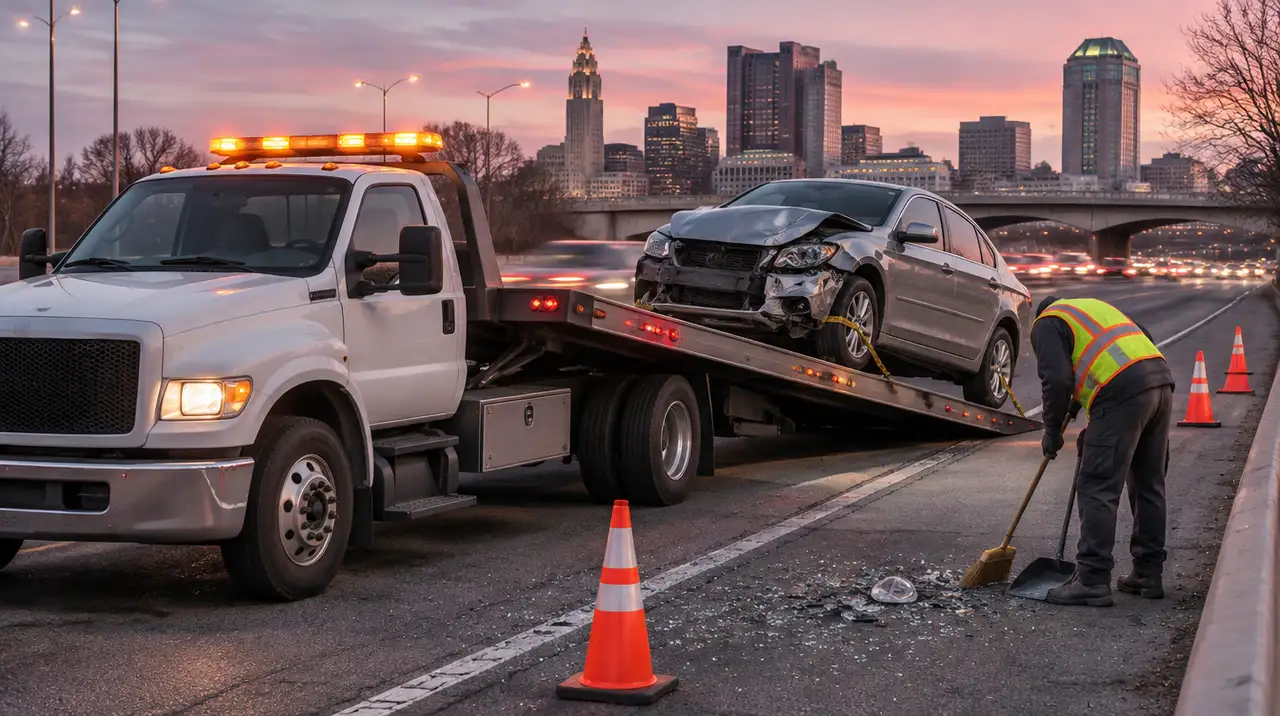
Through downtown Columbus, I-70 and I-71 run on the same pavement for a short stretch along the south edge of the city center, with ramps coming on and peeling off every few hundred feet. Drivers call it the split, and a crash there feels different from one on an open freeway: the shoulders are narrow or missing, traffic is merging on both sides of you, and two interstate numbers on the signs make it hard to say where you actually are. This guide walks through staying safe, working out your position, and getting the car off the highway. When it cannot be driven, our accident towing in Columbus team loads it, picks up the vehicle debris and bills your insurer.
Call 911 first when it is serious
Call 911 before anyone else if a person is hurt, if a car is smoking, burning or leaking heavily, or if any car is sitting in a live lane. That last point matters more in the split than almost anywhere in Central Ohio, because a stopped car in the overlap often has fast traffic merging toward it from a ramp it cannot see. A tow can wait until police have the scene protected.
While you wait for help in a lane, keep your seat belt fastened, keep the hazard lights flashing and stay in the car. Do not get out to look at the damage, trade information or wave traffic around you. People on foot in the downtown overlap are hard for other drivers to see, especially at night or in rain.
If the car still moves, get out of the overlap
A minor bump where both cars still steer and roll is a different situation. The goal is to get both cars away from the merge points without crossing lanes in a hurry. Some practical options:
- Take the next exit you can reach without cutting across traffic. Downtown street exits drop you onto city streets within a few blocks, where a side street or a parking lot is far safer than a freeway shoulder.
- Agree on a spot with the other driver if you can do it without leaving your car, for example by pointing to the exit ahead. If you cannot, stop at the first safe place and call 911 so the officer can sort it out.
- Do not back up on a ramp or the main line to reach a wider patch of shoulder, and never reverse toward an exit you just missed.
- If the car pulls hard, scrapes, smells hot or shows a red warning light, stop as soon as it is safe and treat it as a tow. Our checklist on whether a car is safe to drive after an accident covers the signs.
Why the split is hard to describe
On most freeways, the direction and the last exit tell a tow driver where to go. In the overlap that breaks down in three ways.
First, the road carries two route numbers, and the direction on the signs depends on which one you read. Heading east through downtown on I-70 is also heading north on I-71 for part of the way, so "I-71 north" and "I-70 east" can describe the same lane. Second, the ramps sit so close together that the exit you just passed and the one ahead may be only blocks apart, and several ramps can be reached from one direction only. Our I-70 towing page notes, for example, that the Parsons Avenue exit is eastbound only. Third, the area has been under construction for years, so lane shifts, temporary barrier walls and ramp changes can make the road look different from the map in your memory.
How to pin down your location
Take a breath and collect a few details before you call. Any two or three of these usually put a truck in the right spot:
- Where you came from. "I came off SR-315 heading east" or "I was coming up I-71 from Grove City" tells dispatch which side of the overlap you entered.
- Where you were headed. Name the route you meant to stay on, such as I-70 toward Whitehall and Reynoldsburg, or I-71 north toward campus and Polaris.
- The last sign you read. A downtown street name on an exit sign, such as Parsons Avenue, is as useful as an exit number.
- What you can see. The Scioto River, the downtown skyline on one side, German Village or the Brewery District on the other, a hospital, a stadium or a bridge overhead.
- Your spot in the road. Right shoulder, left side against the barrier, on a ramp, or stopped in a lane.
- Your phone's map. The blue dot settles it. You can send that exact position from our SOS request page, which saves reading it out over the noise of traffic.
If you are unsure, say so. "I think I just passed the Parsons Avenue sign, heading east" gives the driver something to work with, and the dispatcher will ask follow-up questions.
The ends of the overlap
The west end. Near the Scioto River, SR-315 begins at the I-70 and I-71 interchange southwest of downtown, and I-670 leaves I-70 on the west side of the city center heading toward the airport. A crash on these ramps often happens where traffic from three routes is sorting itself out. Tell dispatch which two roads your ramp connects, such as "the ramp from I-71 south onto SR-315." Our SR-315 towing page covers the first exits on 315, and the Grandview Heights side sits just north of them.
The east end. On the east side of downtown, I-71 turns north toward the University District and I-70 carries on east toward Bexley, Whitehall and Reynoldsburg. If you crashed after the roads separated, say which of the two you ended up on. The I-71 towing page lists the exits north of downtown.
When an officer arrives
In the downtown overlap the responding officer may be from Columbus police or the Highway Patrol. Either way, the officer runs the scene: they decide when cars can move, the order of work while lanes are closed, and in some cases who tows a car that cannot be driven. Tell them plainly whether your car still drives and whether you already have a tow on the way.
Our guide to police-called tows after a crash in Columbus explains when the driver picks the tow company and when the officer makes that decision. We respond to crash scenes 24/7; when the officer allows you to choose, you can request us at (740) 812-9489. Passing along the arrival estimate our dispatcher gives you helps the officer plan the lane closure.
What to have ready for dispatch
- Your location, using the clues above.
- The car: year, make and model, and whether it is electric, hybrid or all-wheel drive.
- The damage: does it roll and steer, is anything leaking or dragging, did airbags deploy. If they did, see our post on driving after the airbags go off.
- Where it should go: a body shop you trust, or our lot while the insurer decides.
- Your claim number if you already have one. If not, it can come later.
Arrival times are estimates, never promises: most metro calls are reached in 20–40 minutes, outer communities in 40–60. Downtown traffic and lane closures can add to that, and the dispatcher will tell you honestly what to expect.
How we handle a crash tow downtown
Our operator checks in with the officer first, then loads the car as quickly as the scene allows so the lane can reopen. A damaged car usually rides on a flatbed so a bent wheel or broken suspension part does not have to turn. All-wheel-drive cars are not towed with two wheels on the road. Electric cars travel with all four wheels off the ground, on a flatbed or a wheel-lift with dollies, as the manufacturer directs, and a damaged EV is stored apart from other cars, as our post on EV storage safety explains.
Before pulling away, the operator sweeps the glass, plastic and loose parts that came off the car we are towing and puts absorbent on small drips from it. Then the car goes where you decide: straight to your repair shop, or to our storage lot at 1620 Harrisburg Pike to await instructions. If you have no shop in mind, dispatch can suggest one from our auto repair partners.
Cost and who pays
On accident tows we bill your insurer directly. For reference, our standard tow is a $125 hookup plus $7 per loaded mile and $4 per mile for the drive out from our yard. Storage is $45 a day and starts the day the car is towed, so getting the adjuster out and a shop chosen early keeps the total down. Every charge is listed on the pricing page, and dispatch quotes the price before hookup.
For the full picture of what happens after a collision, from the scene to the claim, see our accident and collision towing page and the step-by-step guide to a crash on a Columbus freeway. If the car simply quit in the split without a crash, our emergency towing covers that too.
Frequently asked questions
What should I do after a crash in the I-70/I-71 split?
Call 911 first if anyone is hurt, a car is smoking or leaking heavily, or a car is stopped in a travel lane, and stay buckled in with the hazards on while you wait. If both cars still drive and nobody is hurt, take the next exit you can reach without cutting across lanes and stop on a city street or in a parking lot. Then call for a tow if the car should not be driven.
How do I tell a tow truck where I am in the downtown split?
Say where you came from, where you were headed, and the last street name you saw on a sign, such as Parsons Avenue. Add what you can see, like the Scioto River or German Village, and whether you are on a ramp, a shoulder or in a lane. Sending your phone's location from our SOS request page is the quickest way to remove any doubt.
Is I-71 north the same road as I-70 east downtown?
For a short stretch along the south edge of downtown, yes. The two interstates share the same lanes, so a driver on I-71 north and a driver on I-70 east can be in the same place. That is why naming both the route you entered from and the one you were heading for helps dispatch.
Should I get out of my car after an accident in the split?
Usually not. Shoulders in the overlap are narrow and traffic merges from ramps on both sides, so the safest place is normally inside the car with your seat belt on and the hazard lights flashing. Get out only if the car is on fire or filling with smoke, and move well away from traffic.
Can I choose who tows my car after a downtown crash?
Often, but the officer at the scene has the final say. When the officer allows you to choose, you can request Roadside Towing & Recovery Inc and give the officer our dispatcher's arrival estimate. Our guide to police-called tows in Columbus explains when the officer makes that decision instead.
About this guide: it is general safety guidance for drivers based on practical experience, and it does not quote outside statistics or rules. Road layouts in the split change with construction, so follow the signs and the directions of police and road crews at the scene. This post is general information, not legal advice.
Crashed in the downtown split and the car should not move? If anyone is hurt or a car is in a lane, call 911 first. Then call (740) 812-9489 at any hour with where you came from and where you were headed, or send your location from the SOS request page.