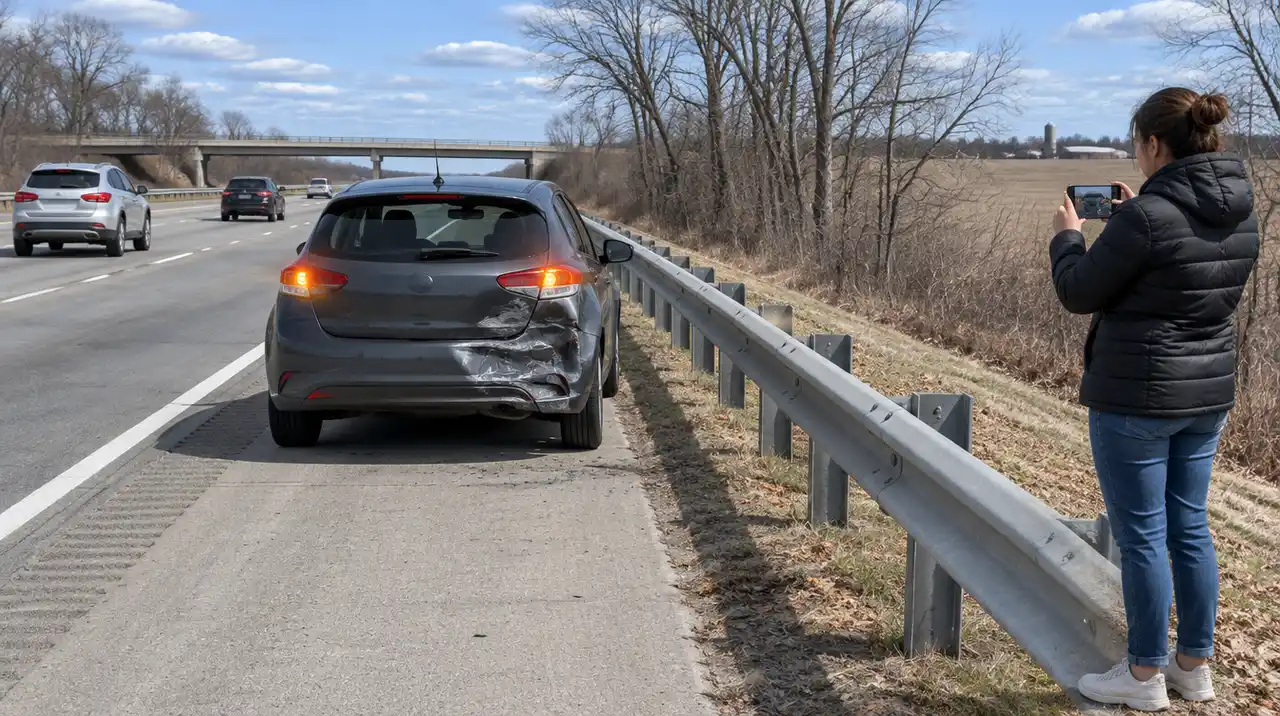
A crash on I-270 leaves you on a shoulder that looks like every other stretch of the outerbelt: concrete barrier or guardrail, a grass slope, a ramp somewhere ahead. When you call for help, the first question is always "where are you?", and "on 270" is not an answer anyone can drive to, because the loop runs all the way around Columbus. This guide covers staying safe, working out exactly where you are, and giving a location that gets help to the right side of the road. When the car cannot be driven, our accident towing in Columbus loads it, clears the vehicle debris and bills your insurer.
Safety before anything else
If anyone is hurt, if a car is smoking, burning or leaking heavily, or if a car is stopped in a live travel lane, call 911 before anything else. A tow can wait.
If the cars still move and no one is hurt, ease onto the right shoulder, or the next exit ramp if it is close and you can get there without crossing lanes. Turn on the hazard lights. Most of the time the safest place to wait on a freeway shoulder is in the car with your seat belt on, unless you can walk away from traffic to stand behind a guardrail. Never stand between your car and the lanes, and do not cross the highway on foot to talk to the other driver.
Why the outerbelt confuses everyone
I-270 is a ring, so the direction on the signs depends on which side of Columbus you are on. "I-270 northbound" could mean the west side near Hilliard or the east side near Gahanna, which are far apart in traffic.
It also crosses I-70 twice, I-71 twice and every major road out of the city, with collector lanes and stacked ramps at several junctions. After a crash it is easy to lose track of which one you just passed.
How to pin down where you are
Before you call, look around for these clues:
- The last exit you passed and the next one ahead. "After Tuttle Crossing, before US-33" puts a truck on the right side of the road in one sentence. Street names work as well as exit numbers.
- Your side of the road. Right shoulder, left shoulder against the median wall, on a ramp, or in the collector lanes beside the main highway.
- A landmark you can see. An overpass, a mall, an office park, a hotel, a water tower, a big-box store sign just off the highway.
- Your phone's map. Open your map app and look at the blue dot. You can send that exact spot to us from the SOS request page, which is the quickest way to share it.
If you are not sure, say so. An honest "I think I passed Roberts Road" beats a confident guess that sends a truck the wrong way around the loop.
The outerbelt, one quarter at a time
Southwest and west. Our yard sits near the outerbelt where US-62 and SR-3 cross it, on the Harrisburg Pike side of town. Heading north from there, the loop passes US-40 and Broad Street on the Galloway side, then Roberts Road, then Cemetery Road and Fishinger Boulevard in Hilliard, then Tuttle Crossing Boulevard.
Northwest and north. The big interchange on the Dublin side is US-33 and SR-161. Across the top of the loop, US-23 is signed for Worthington and Delaware, and the I-71 interchange follows to the east. Then come SR-3 on the Westerville edge, Cleveland Avenue and State Street.
Northeast and east. SR-161 is the New Albany exit, then Morse Road and the Easton exits, which use collector lanes shared with SR-161. If you crashed near Easton, tell dispatch whether you were on the main line or in those side lanes, because they look the same in the dark. Next is I-670 and US-62 for the airport and Gahanna, then Hamilton Road toward Whitehall.
Southeast and south. US-40, Main Street, serves Reynoldsburg, and then the loop crosses I-70 again before the US-33 exits toward Bexley and Lancaster. Along the south side, the loop passes US-23 at South High Street near Lockbourne and the I-71 interchange on the Grove City side before coming back around to US-62.
Our I-270 towing page covers each part of the loop in more detail.
If you crashed on a ramp or in an interchange
Ramps are narrow and often have little shoulder. If you can safely roll off the end onto a side street or parking lot, wait there. If not, stay buckled in with the hazards on and call 911.
When you describe a ramp, say which two roads it connects and which way you were going: "the ramp from I-270 to I-71 southbound" or "the Hamilton Road exit ramp coming off the loop." Some ramps can only be reached from one direction, so this detail saves real time.
When police are on the scene
The officer who arrives may be from the Highway Patrol, Columbus police or a suburban department. Whoever it is runs the scene: they decide when cars can move and, in some cases, who tows a car that cannot be driven. Tell the officer plainly whether your car still drives.
Our guide to police-called tows after a crash in Columbus explains when you get to choose the tow company and when the officer makes the call. We respond to crash scenes 24/7; when the officer allows you to choose, you can request us at (740) 812-9489. Give the officer the arrival estimate our dispatcher gives you.
What to tell our dispatcher
- Location: last exit, next exit, which shoulder or ramp, and any landmark.
- Vehicle details: make, model and year, plus whether it is an EV, a hybrid or has all-wheel drive.
- The damage: whether it rolls and steers, any leaking, and whether the airbags went off.
- Destination: a body shop you already trust, or our lot while the insurer decides.
Any arrival time is an estimate, not a promise: most metro calls are reached in 20–40 minutes, outer communities in 40–60. Because our yard is next to the southwest part of the loop, a crash on that stretch is often reached in 15–30 minutes.
Unsure whether to drive it? See our checklist on whether a car is safe to drive after an accident, and for the full scene-to-claim order, see crash on a Columbus freeway: what to do, step by step.
How we handle an outerbelt crash tow
Our operator checks in with the officer if one is there, then loads the car. A crashed car usually goes on a flatbed so no damaged wheel has to turn. All-wheel-drive cars should not be towed with two wheels on the road, and electric cars travel with all four wheels off the ground, on a flatbed or a wheel-lift with dollies as the manufacturer allows. If the car went down the slope or into the median, a winch-out recovery brings it back up to the pavement first.
Before leaving, the operator sweeps up the glass, plastic and parts that came off the car we are towing and puts absorbent on small drips from it. The car then goes where you choose: straight to your body shop, or to our storage lot at 1620 Harrisburg Pike to wait for the insurer's instructions. If you do not have a shop yet, dispatch can suggest one from our auto repair partner network.
What it costs and who pays
On accident tows we bill your insurer, so have the claim number ready when you can. For reference, a standard tow with us is a $125 hookup, $7 for each mile the car is on the truck, and $4 a mile for the drive from our yard. Storage at our lot is $45 a day, starting the day the car is towed, so the sooner the adjuster sees the car and a shop is chosen, the fewer days end up on the bill. Every other charge is on the pricing page, and dispatch quotes the price before anything is hooked up.
For everything else about crash towing, see our accident and collision towing page. For a breakdown without a crash, our emergency towing covers the whole loop.
Frequently asked questions
What should I do right after an accident on I-270?
Call 911 first if anyone is hurt, a car is burning or leaking heavily, or a car is stopped in a travel lane. If the cars still move and no one is hurt, get onto the right shoulder or the next ramp and turn on your hazards. Then work out the last exit you passed before you call for a tow.
How do I describe where I am on the Columbus outerbelt?
Give the last exit you passed and the next one ahead, such as after Tuttle Crossing and before US-33, plus which shoulder or ramp you are on. Because I-270 is a ring, a direction like northbound alone can point to two very different places. You can also share your phone's map location from our SOS request page.
Should I stay in my car after a crash on the I-270 shoulder?
Usually the safest choice is to stay in the car with your seat belt on and the hazards flashing. The exception is when you can walk away from traffic and stand behind a guardrail, or the car is smoking or on fire. Never stand between the car and the travel lanes.
Can I choose the tow company after a crash on I-270?
Often, but not always. The officer at the scene decides when cars can move and, in some cases, who tows a car that cannot be driven. When the officer allows you to choose, you can request Roadside Towing & Recovery Inc and give the officer our dispatcher's arrival estimate.
Where does my car go after an outerbelt accident tow?
Wherever you choose: straight to your body shop, or to our storage lot on Harrisburg Pike to wait for the insurer's instructions. On accident tows we bill your insurer, and storage is charged daily from the day of the tow, so choosing a shop early keeps the bill down.
About this guide: it is general safety guidance for drivers, not a driving course or insurance advice, and it does not cite outside rules or statistics. Follow the directions of police, fire and road crews at the scene. This post is general information, not legal advice.
Crashed on the outerbelt and the car should not move? Injuries or a car in a lane mean 911 comes first. After that, call (740) 812-9489 any hour with your last exit and your side of the road, or send your location from the SOS request page.