Tesla, Rivian, Ford Lightning, Hyundai Ioniq, Chevy Bolt: every electric vehicle we move travels with all four wheels off the pavement, on a flatbed or a wheel-lift with dollies, following its manufacturer's towing instructions. Dead 12V, out of charge, collision or software lockout, we handle it around the clock.
Why an Electric Car Travels With All Four Wheels Off the Ground
Most people learn this on the shoulder of I-270: an electric car has no real neutral. The motors sit right on the driven axles, so if a wheel turns, the motor turns with it and starts acting like a generator, pushing current back into a drive system that is not awake to handle it. Tesla's owner's manual puts it bluntly: never tow the car with the tires contacting the ground, even for short distances. Ford says every wheel on the F-150 Lightning has to be off the ground, and GM says a Bolt towed on its wheels can damage the drivetrain and void the warranty.
So our rule is simple: all four wheels off the ground, every time, using a method the car's owner's manual approves. There are two. A flatbed carries the whole car on the bed; it is the method Tesla recommends and the one we use for longer trips, whether that is a flatbed tow on SR-315 from a shoulder by Ohio State or a run across the county. A wheel-lift with dollies lifts one axle and puts the other on dollies, so every tire is still off the pavement; it is often the best option in tight parking lots, garages and driveways where a flatbed cannot fit, used within each manufacturer's limits (Tesla caps it at 35 miles). Dispatch picks the method that fits the car, the distance and the spot it is sitting in.
A dead EV adds a wrinkle: without power, the parking lock stays engaged and the wheels will not roll. If the 12V battery can be jumped, the car can usually be put into transport mode, which frees the wheels. If it cannot, that is what dollies and skates are for: they take the weight so the car moves with its wheels locked and nothing is dragged.
Most of our EV calls in Columbus are not crashes. They are a dead 12V battery that has locked the doors, a car that ran out of charge two miles short of the Polaris Supercharger, or a software glitch that will not let the car shift. We carry jump packs to wake the low-voltage system and we know the procedure for opening a Tesla frunk with no power. Then we take the car where you want it: Tesla's service center at Easton, a partner shop, your home charger or the nearest charging station.
Flatbed or wheel-lift with dollies? What each manufacturer says
You will see both methods on our trucks and in our articles, and they do not conflict. Each one keeps all four wheels off the ground, which is the rule every EV maker sets. What differs is which method a manufacturer prefers and how far it allows a car to ride on dollies, so the owner's manual and the length of the trip decide which one your car gets. More detail is in our article on why an electric car rides on a flatbed or a wheel-lift and dollies.
What the owner's manuals say:
Tesla (Model 3, Y, S, X, Cybertruck): a flatbed is the recommended method. A wheel-lift with dollies is allowed with all four wheels off the ground, for no more than 35 miles and within the dollies' speed rating.
Ford F-150 Lightning and Mustang Mach-E: Ford recommends a wheel-lift and dollies or flatbed equipment, and all-wheel-drive versions need every wheel off the ground.
Chevrolet Bolt EV and EUV: GM calls for a flatbed, and allows a wheel-lift with properly rated dollies when a flatbed is not available.
Hyundai Ioniq 5: all-wheel-drive versions must be towed with a wheel-lift and dollies or a flatbed, with all the wheels off the ground.
Any other EV, including Rivian: tell dispatch the make, model and year, and we follow that manufacturer's towing instructions.
How damaged EVs are stored safely
A crashed, flooded or burned electric car can stay dangerous after the tow. Energy left in a damaged battery can start thermal runaway hours or days later: in the NTSB's 2020 study of three EV crash fires, the batteries reignited at least 15 times, including at the impound yard. The documented risks are fire, reignition and toxic, flammable gas, and that gas is most dangerous when it collects in an enclosed space. So the recommended practice for tow and storage yards is built around open air and distance.
Our full guide, storing damaged electric vehicles safely, cites each source and notes where they disagree, including the NTSB's finding that a 50-foot clear area is often not possible in a real tow yard.
What federal and fire-service guidance recommends:
Outdoors, never inside a building: NHTSA says not to store a severely damaged EV inside a structure.
50 feet from structures, other vehicles and combustibles (NHTSA, Tesla and the U.S. Fire Administration), or a barrier of earth, steel, concrete or solid masonry when space is short (SAE J2990, as summarized by the NTSB).
Keep checking it: watch for smoke, sparks, leaks, heat, or popping and hissing from the battery, use a thermal camera where available, and call 911 at the first sign.
Follow the manufacturer's emergency response guide for that model, and leave a damaged EV unplugged until a qualified shop has inspected it.
Keep clear access so the fire department can reach the car; an EV battery fire can take thousands of gallons of water.
Latest EV towing guides from our team
New articles for Columbus EV drivers, newest first.
Out of warranty? Great Lakes EV repairs it, we tow it there
When an electric car is past its factory warranty, the dealer is rarely the best fit. We are the exclusive Columbus towing provider for Great Lakes EV, an independent Dayton shop that repairs EVs no longer covered by the manufacturer, from Tesla drive units to Model S and Model X battery faults. We carry the car to Dayton with all four wheels off the ground and can bring it home when the repair is done.
From a recent job: a Tesla Model S loaded four wheels up
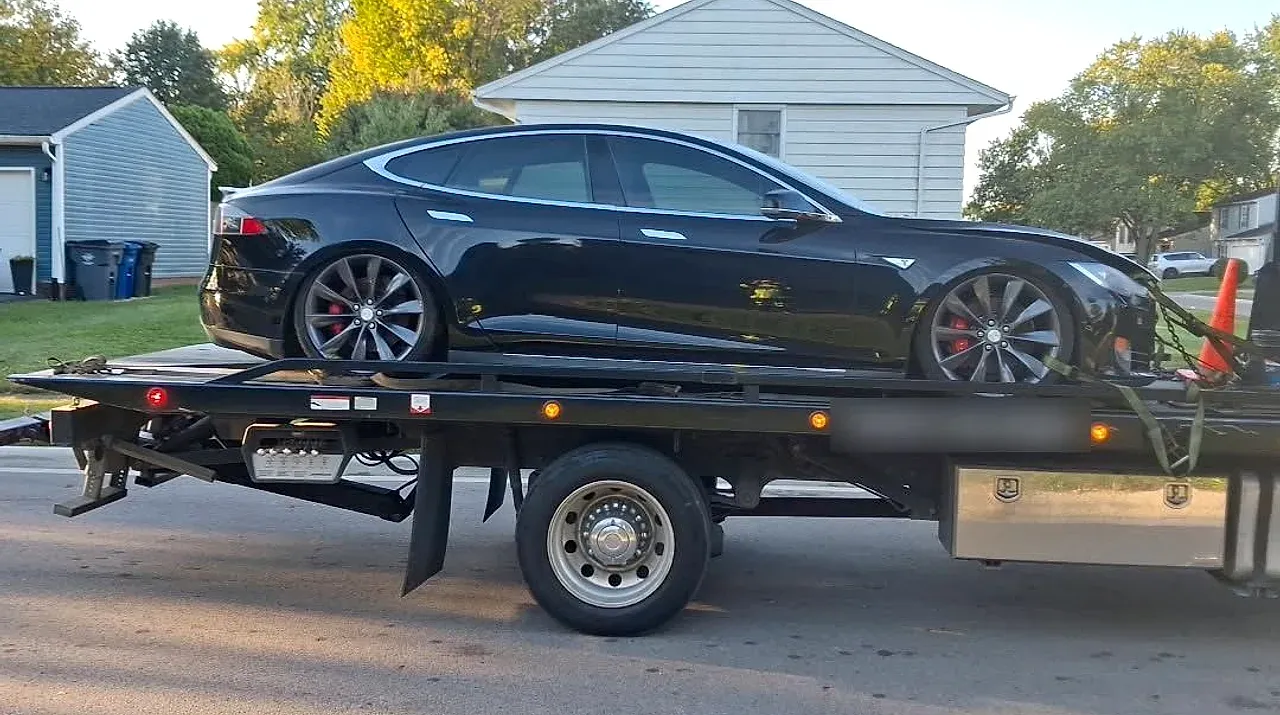
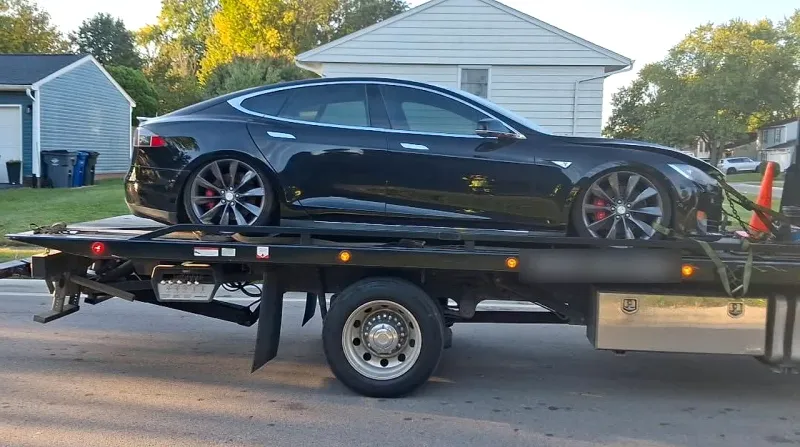
This Model S P85D was moved recently in the Columbus area. The D stands for dual motor, one on each axle, so neither end of the car can roll on the pavement without turning a motor. It rode with all four wheels off the ground: the front tires came onto the bed over ramp boards at the tail to protect its low nose, and soft straps around the tires held it in place with nothing hooked to the body or suspension. More on handling cars that sit this low is on our low-profile towing page.
A Tesla Model S P85D on our flatbed: every wheel off the pavement, held by soft straps around the tires.
Key features
Four Wheels Up, Every Time: No EV leaves the scene with a tire on the pavement. It rides on a flatbed or on a wheel-lift with dollies, whichever its manufacturer allows for the car, the distance and the space.
Wheel-Lift With Dollies: Often the best option in tight parking lots, garages and driveways where a flatbed cannot fit: one axle on the lift, the other on dollies. Used within each manufacturer's limits, such as Tesla's 35-mile cap.
Dead EV? Dollies and Skates: Without power the parking lock stays engaged and the wheels will not roll. Dollies and skates carry the car so it moves without dragging a locked wheel.
12V Jump to Wake the Car: A dead 12V (or 16V lithium pack on newer Teslas) is the most common EV call. Jumping it can let the car unlock and enter transport mode, which frees the wheels.
Tesla Frunk With No Power: Tesla's manual shows a pair of leads behind the tow-eye cover in the front bumper. Powering those pops the frunk so the 12V terminals can be reached. We know the procedure and bring the right connectors.
Drop-Off Where It Makes Sense: Tesla Service Center at Easton, Tesla Collision in Dublin, an independent partner shop, your driveway and Level 2 charger, or the closest Supercharger. You choose, we deliver.
Why choose Roadside Towing & Recovery Inc
We treat the manufacturer's towing guidance as the rule, not a suggestion. Tesla, Ford and GM all say keep the driven wheels off the pavement, so that is how the car leaves the scene: four wheels up, every time.
The right method for the car and the trip: a flatbed for longer runs and whenever the manual calls for one, a wheel-lift with dollies for tight lots, garages and driveways.
A jump pack rides on every truck. Most Tesla lockouts and dead-car calls are a low-voltage battery, not the big pack, and waking it up is often the first step to freeing the wheels.
Dollies and skates mean a dead EV with its parking lock engaged still moves without a wheel dragging on the ground.
24/7 dispatch at (740) 812-9489, and most Columbus-metro calls are reached in 20 to 40 minutes. EV calls are often on I-270, I-71 or in a downtown garage, and we run all of it.
How it works
Call or Quote Online: Tell us the make and model, what happened (dead 12V, out of charge, collision, will not shift) and where the car sits. That tells us whether to bring a jump pack, dollies, skates or a flatbed. Call (740) 812-9489 or build an EV quote online.
Wake the Low-Voltage System: If the car is dead, we try to jump the 12V or 16V battery first. On a Tesla with no power we use the leads behind the front tow-eye cover to open the frunk, then jump at the posts under the hood. Once the screen is up, transport mode can free the wheels.
Load With All Four Wheels Up: On a wheel-lift, one axle goes on the lift and the other on dollies; on a flatbed, the car is winched onto the bed at walking speed. If the wheels are still locked, dollies or skates take the weight so nothing drags.
Secure and Deliver: The car is secured with every tire off the pavement, then we drive to Tesla at Easton, a partner shop, your home charger or the nearest Supercharger and unload the same careful way.
Frequently asked questions
Can you tow a Tesla in Columbus?
Yes. Model 3, Model Y, Model S, Model X and Cybertruck all travel with all four wheels off the ground, which is what Tesla's owner's manual calls for: on a flatbed, the method Tesla recommends, or on a wheel-lift with dollies for trips within Tesla's 35-mile limit. If the car has power, you or the driver puts it in transport mode from Controls, then Service, then Towing on the screen. If it has no power, we try to jump the low-voltage battery first. We tow to the Tesla Service Center at 4099 Easton Loop West, Tesla Collision in Dublin, or wherever you prefer.
Does towing damage an electric car?
It can if it is done wrong. EVs do not have a transmission that disconnects the motor from the wheels, so towing with any driven wheel on the ground spins the motor and generates current the system is not ready for. Tesla's manual warns this can cause significant damage and overheating that the warranty does not cover, and Ford and GM say the same about the Lightning and the Bolt. With all four wheels off the ground, on a wheel-lift with dollies or a flatbed, towing is no harder on an EV than on any other car.
Do you tow EVs on a flatbed or a wheel-lift?
Both, and they are not in conflict: each keeps all four wheels off the ground, and the owner's manual decides which one your car gets. Tesla recommends a flatbed and allows a wheel-lift with dollies for up to 35 miles. Ford recommends a wheel-lift and dollies or a flatbed for the Lightning and Mach-E. GM calls for a flatbed on the Bolt, with dollies allowed when no flatbed is available. A wheel-lift with dollies is often the best option in tight parking lots, garages and driveways; a flatbed suits longer trips. Dispatch chooses based on your car, the distance and where it is parked.
My EV is completely dead and the wheels will not turn. Can you still move it?
Yes. Without power, an EV's parking lock stays engaged, so the wheels will not roll. If the 12V battery can be jumped, the car can usually be put into transport mode, which frees the wheels. If it cannot, we move the car on dollies or skates, which carry the weight so the locked wheels never drag on the pavement.
My Tesla's 12V battery is dead and the doors will not open. What now?
This is our most common Tesla call. Tesla's manual describes a small cover over the tow eye in the front bumper; behind it are two leads. Putting a 12V jump pack on those leads pops the frunk. From there the low-voltage battery, either a lead-acid 12V or the newer lithium-ion pack, can be jumped at the posts under the hood. Tesla's manual says to keep the power supply connected only briefly on the lithium-ion type, and never use the Tesla itself to jump another car. Once the screen wakes up, transport mode can free the wheels.
I ran out of charge on I-270. Can you take me to a Supercharger?
Yes. Depending on where you are, the closest options are usually the Polaris Supercharger at Polaris Towne Center on Polaris Parkway, the Dublin Supercharger at the Meijer on Sawmill Road, the one at the Greater Columbus Convention Center downtown, or the Meijer on Hilliard Rome Road. If home is closer and you have a wall charger, we can drop the car in your driveway. A car at zero percent can still enter transport mode as long as the 12V system is alive; if it is not, dollies do the job.
Do you tow Rivians, Ford Lightnings, Ioniqs and Bolts too?
Yes, all with every wheel off the ground. Ford says the Lightning is four-wheel drive and needs every wheel off the ground or it may generate electricity and damage itself. GM says a Bolt towed on its wheels risks drivetrain damage not covered by warranty. Hyundai's manual allows a dolly setup on the Ioniq 5. Tell dispatch the make and model so we bring the right setup, and note that a Rivian or a Lightning is a large vehicle, so the large-vehicle surcharge applies.
How much does an EV tow cost?
EV and Tesla tows are billed on their own published rate card: an en-route charge per mile from our yard, a hook-up fee and a per-loaded-mile rate, with surcharges only when they apply (highway pickup, after-hours, weekends, large vehicles such as a Lightning or an R1T). A 12V jump on its own is the flat roadside rate plus the en-route fee. The current numbers are in the Pricing block on this page, and the EV quote builder gives you an exact total before you book.
Where do you take my EV?
Wherever you say. The common destinations are the Tesla Service Center at 4099 Easton Loop West in Columbus, Tesla Collision Center on Britton Parkway in Dublin, a franchise dealer for Ford, Hyundai, Chevy or Rivian, one of our independent partner shops, or your own garage so you can charge at home. Tell dispatch the address when you call and we will confirm the mileage before we roll.
How do I put my Tesla in transport mode before the tow truck gets there?
Tesla's manual lists a few conditions: the car needs 12V power, it must detect a key, and it should not be plugged into a charger. Put it in Park, press and hold the brake, then go to Controls, Service, Towing and choose to enter transport mode. If you are unsure, leave it for our driver. If the screen is black, skip this step and tell dispatch, because transport mode cannot be switched on without low-voltage power.
Can I flat-tow my Tesla or another EV behind an RV?
Not a Tesla. Tesla's transport instructions say to move the car with all four tires off the ground and never let them spin, which rules out pulling it four-down behind a motorhome. Ford says the same of the F-150 Lightning, and GM warns that towing a Bolt on its wheels can damage the drivetrain. Check your own manual before planning a trip, and if the car breaks down on the road, we move it on a wheel-lift with dollies or a flatbed.
Can you jump my EV enough to drive it to a charger?
No, and that surprises a lot of drivers. A jump only feeds the small low-voltage battery that runs the locks, screen and computers. The high-voltage pack that actually moves the car is separate, and a jump adds no range to it. So an EV showing zero miles needs a tow, not a boost, and we carry it with all four wheels off the ground to the charger, garage or shop you pick.
Can I push my dead EV out of the way?
If it stopped in a travel lane, get everyone to a safe spot away from traffic and call 911 first; do not stand behind it pushing. Otherwise, an EV with power can roll only briefly: Tesla's Model Y manual limits transport mode to winching or repositioning, under 3 mph and for less than 30 feet. One with no power is different, because the parking lock holds the wheels and pushing gets nowhere. Leave it in place and let dollies or skates do the moving.
Where should a damaged EV be stored after a crash or flood?
Outdoors and away from everything else. NHTSA's guidance says not to store a severely damaged EV inside a structure or within 50 feet of a structure, another vehicle or combustibles, and that applies to your own garage too. Tesla and the U.S. Fire Administration use the same 50-foot figure, and SAE J2990 allows a barrier of earth, steel, concrete or solid masonry when there is not enough room. A damaged battery can reignite hours or days later, so the car should also be checked for smoke, heat or popping while it sits. Our guide to storing damaged EVs safely has the details and sources.
Can I charge my EV after it was in a flood or a crash?
Not until a qualified shop has inspected it. NHTSA says to assume a damaged high-voltage battery is energized and fully charged, and Tesla says a car that has been submerged should not be operated until an authorized shop has looked at it. Leave it unplugged, keep it outside and away from the house, and call 911 if you see smoke or hear popping or hissing from the battery.
What should I have ready when the EV tow truck arrives?
Keep the key card, fob or phone key with you, because Tesla's manual says the car has to detect a key before transport mode will turn on, and the driver may need it to unlock the car. Unplug the charging cable if one is connected. Tell dispatch the make, model and trim, whether the screen lights up, whether the wheels roll, and the garage level if it is parked indoors, so we bring the right equipment.
Does towing a Tesla charge it?
No. Towing an EV with its drive wheels rolling does not charge it in any useful way, and it can overheat and damage the drive motor. An EV is towed with all four wheels off the ground, on a flatbed or with dollies, and taken to a charger, home or a service center.
Do Teslas have a tow mode?
Yes. Tesla calls it Transport Mode: it releases the parking brake so the car can be winched onto a flatbed. It is turned on and off from the touchscreen (Service menu) and needs some 12V power. It is only for winching onto a truck, not for towing on the wheels.
Do you tow a Tesla from the front or back?
Neither end with wheels on the ground. A Tesla goes on a flatbed, or is lifted at one end with dollies under the other wheels, so no wheel turns. Which end goes up first depends on how the car is parked and the space around it.
Can a Tesla be towed without a key?
Yes, but with no key or app access we usually cannot enter Transport Mode, so the parking brake stays on. The car is then moved onto the flatbed with dollies under the locked wheels. Tell dispatch there is no key so the right equipment comes.
What happens when an EV runs out of battery while driving?
The car warns you repeatedly as the range drops, then limits speed and power to stretch the last miles, and finally slows to a stop. Steering and brakes keep working while it coasts, so pull over as soon as the warnings start. Once it stops it cannot be driven or pushed far; it needs a flatbed or dolly tow to the nearest charger.
What if my EV runs out of charge somewhere rural?
Stop where it is safe, keep the hazards on and call for a flatbed tow to the nearest working charger or to home. Outside the metro the nearest fast charger can be many miles away, so tell dispatch your exact location and where you want to go.
Does Tesla provide its own roadside assistance and free towing?
Tesla runs its own roadside program, and what it covers and costs depends on the car, its warranty and the date; check the Roadside section of the Tesla app. We are an independent company, not affiliated with Tesla: call us when you want a tow now, to anywhere you choose, at our published EV rate. Call (740) 812-9489.
Can you push a hybrid car?
Many hybrids can be pushed a few feet in neutral to get them out of a lane, but check the owner's manual, because some must not roll with the system off. For anything more than a few feet, a hybrid should be towed with the drive wheels off the ground.
EV & Tesla Towing across Central Ohio
EV and Tesla towing in Columbus, Ohio comes down to one rule: all four wheels off the ground, every time. Whether the car died in a Short North street spot, on the I-270 outerbelt near Dublin, in an OSU campus garage or at Easton Town Center, we move it the way Tesla, Ford and GM say to move it, on a wheel-lift with dollies or on a flatbed. We bring a jump pack for a dead 12V battery and dollies or skates for a car whose parking lock will not release, and we tow to the Tesla Service Center at Easton or anywhere else in Franklin County.
Ran out of charge near Polaris or Westerville? We carry the car to the nearest Supercharger, your driveway, or a partner repair shop. Tesla's owner's manual says transport mode needs a working 12V system, so we wake the low-voltage battery first when we can; when we cannot, dollies carry the car with its wheels locked. No dragging, and no driven wheel turning under load.
Our 24/7 dispatch covers Columbus, Dublin, Westerville, Worthington, Hilliard, Gahanna, Grove City, Reynoldsburg and the rest of Franklin County, plus the Delaware County side of Polaris. EV pricing is published on its own rate card, with an exact quote from the EV quote builder before the truck leaves. Call (740) 812-9489 and tell us the make, the model and what happened. Most Columbus-metro calls are reached in 20 to 40 minutes.
Pricing
$2.50/mi en-route + $150 hook-up + $7.50 per mile
EV and Tesla towing (all four wheels off the ground) is billed on its own rate card: $2.50 per en-route mile (yard to pickup) + $150 EV hook-up + $7.50 per loaded mile. Highway calls +$100; after-hours (10PM–6AM) +$150; weekend +$50; large vehicle +$100. Ohio sales tax applies.
Winch-out / off-road recovery: $150 per hour. Storage: $75 per day. A 12V jump on its own is $75 plus en-route.
Pay by cash, debit or credit card, or online by card through Stripe (3% card fee). Booking by phone adds a $35 scheduling fee that the online quote builder waives. Veterans: 10% off retail rates, the app-member metro rate or a VIP membership, with a military or veterans ID.
These are full retail rates for customers who are not registered. Active registered Roadside app members pay a metro flat rate of $125 for the first 5 miles, then $5 per loaded mile, with no en-route charge and no after-hours, weekend or highway fees, for small and medium-size cars picked up inside the I-270 loop or up to 3 miles outside it. You must register in the Roadside app to get it: see our VIP Program.