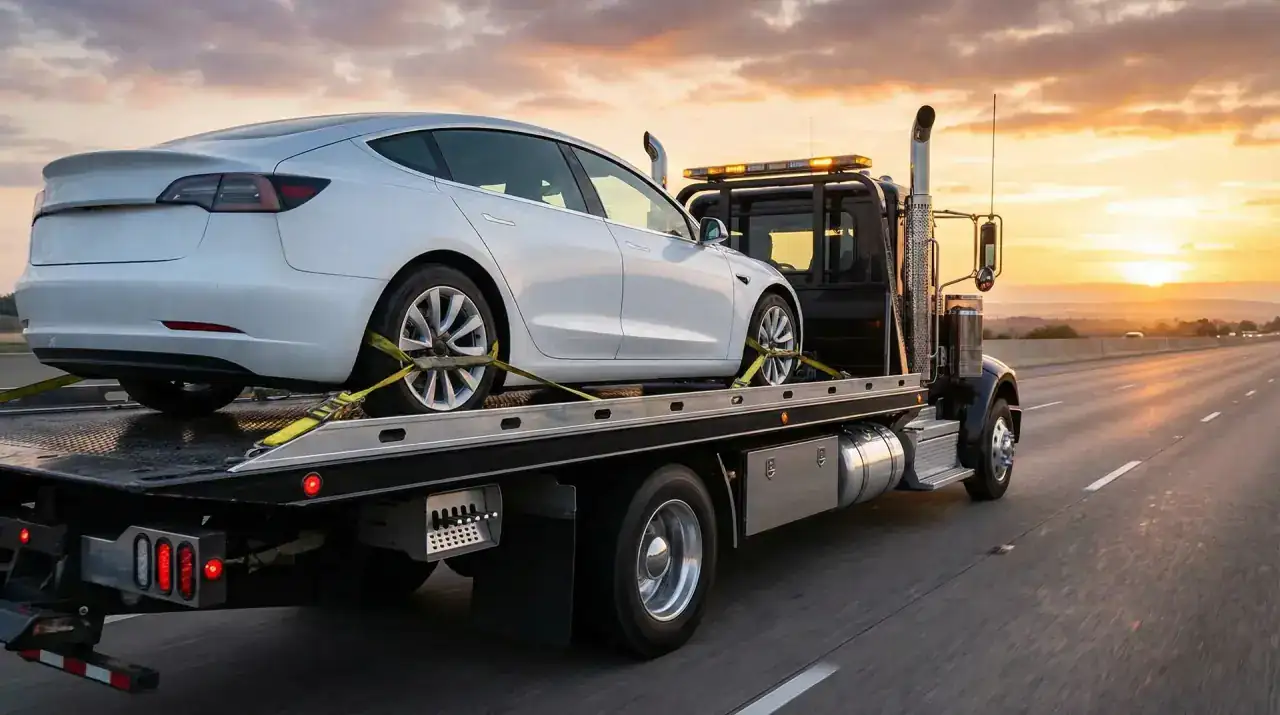
A crashed gas car parked in the back row of a tow yard is just a wreck waiting for an adjuster. A crashed electric car can be something else: a battery that is still charged, partly damaged, and able to heat up and catch fire hours or days after the crash. This guide is for towing companies and tow-yard operators who take in damaged, flooded or burned EVs and want to store them safely. It pulls together what federal safety agencies, the fire service and a vehicle manufacturer actually say, and it points out where those sources disagree.
Everything here is general recommended practice, not a code requirement. Your local fire department and fire marshal set the rules where you operate, and the manufacturer's emergency response guide for the specific vehicle comes first.
Why a damaged EV is a storage problem
The National Transportation Safety Board studied this directly. Its 2020 safety report, Safety Risks to Emergency Responders from Lithium-Ion Battery Fires in Electric Vehicles (NTSB/SR-20/01), looked at three high-speed EV crashes that ended in fire. The NTSB counted at least 15 battery reignitions across those three crashes, and it found the energy left inside a damaged battery, which it calls stranded energy, can cause both electric shock and thermal runaway long after the flames are out.
Several of those reignitions happened in storage. In the Mountain View, California, case, the SUV began popping about 20 minutes after it arrived at the impound yard, the battery reignited less than an hour later, and it reignited again five days after the crash. The same report notes a Chevrolet Volt that caught fire three weeks after a crash test and damaged four nearby vehicles.
The hard part is that you usually cannot tell which damaged pack is the dangerous one. The NTSB says firefighters have no method of determining whether stranded energy is present in a damaged battery or of removing it, and that a damaged battery's status is unknown and has to be treated as a high-voltage safety risk.
What the hazard is, and what it is not
EVs do not routinely explode, and this post is not saying they do. The documented hazards from a damaged lithium-ion pack are fire, reignition, and toxic and flammable gas. NHTSA's interim guidance for towing and recovery operators and vehicle storage facilities (DOT HS 811 576) says venting battery vapors are potentially toxic and flammable, and that damage can cause an immediate or delayed release of those gases and fire.
The explosion risk is about gas collecting in an enclosed space. The U.S. Fire Administration's 2025 guide, Electric Vehicle Fire/Rescue Response Operations, written with the International Association of Fire Fighters, says a battery in thermal runaway releases hydrogen and other vapors that can accumulate, which it calls a particular concern when EVs are parked in enclosed areas. It describes the result as a deflagration: a subsonic explosion without the blast wave of a detonation, but still a severe hazard for anyone nearby. UL's Fire Safety Research Institute ran 21 full-scale experiments in a garage-sized structure and reported in 2024 that accumulated thermal-runaway gas poses an explosion hazard, and that batteries the size of those in EVs may produce enough gas to damage a house.
That is the real reason damaged EVs belong outdoors. Open air lets the gas disperse instead of building up under a roof.
Which vehicles need isolation
The guidance focuses on EVs whose high-voltage battery may be compromised. Tesla's Model Y emergency response guide names three cases: submersion, fire, or a collision that compromised the high-voltage battery. NHTSA's storage rule applies to a severely damaged vehicle with a lithium-ion battery. In practice, flag any EV or plug-in hybrid that:
- was in a crash with damage to the floor, underbody or battery area
- was on fire, or was near a fire, even if the battery looked untouched
- sat in floodwater
- shows any sign NHTSA lists: leaking fluids, sparks, smoke, flames, rising temperature, or gurgling, popping or hissing from the battery compartment
If you see those signs at any point, NHTSA's instruction is simple: call 911.
Isolation distance: who says 50 feet
Fifty feet comes up again and again, but each source words it a little differently:
- NHTSA (tow operators and storage facilities): do not store a severely damaged vehicle with a lithium-ion battery inside a structure or within 50 feet of any structure, vehicle or combustibles.
- Tesla (Model Y emergency response guide): store it in an open area at least 50 feet (15 m) from any exposure, and after a fire, outside at a safe distance of 50 feet from other vehicles and structures.
- NFPA (emergency field guide, as summarized by the NTSB): do not store a vehicle with a damaged or burning lithium-ion battery within 50 feet of a structure or another vehicle until the battery is discharged.
- SAE J2990 (as summarized by the NTSB): either separate the vehicle from combustibles and structures by 50 feet on all sides, or build a barrier around it.
- USFA and IAFF (2025): keep crashed or burned vehicles at least 50 feet from other vehicles and structures, or use a containment area or fire-resistive bunker when space is limited.
Where they differ: NFPA ties the distance to the battery being discharged, while NHTSA and Tesla give no end point. SAE J2990 and the USFA treat a barrier as an alternative to distance; NHTSA and Tesla do not mention one.
And the NTSB was blunt about the gap between the rule and real yards. It concluded that a 50-foot clear radius may be infeasible at tow or storage yards. None of the yards in its crash cases could provide it: the Lake Forest SUV sat about 40 feet from vehicles on two sides, 20 feet on a third and 10 feet from a concrete wall on the fourth, and Fort Lauderdale debris was placed about 20 feet from other objects. The NTSB added that if a yard held more than one such EV, giving each enough space would most likely be impossible. That is where barriers come in.
A quarantine area with barriers or fire-rated walls
When you cannot get 50 feet, the recognized alternative is a physical barrier. As the NTSB summarizes it, SAE J2990 calls for a barrier of earth, steel, concrete or solid masonry around the vehicle. The USFA guide mentions containment areas and fire-resistive bunkers that would prevent fire spread should ignition occur.
Be clear about what a wall is for. A barrier limits fire spreading to the cars and buildings next to it. It does not stop a battery from venting gas, and none of these sources describe walls as a way to prevent explosions. The protection against gas build-up is keeping the vehicle outdoors in open air. So a quarantine bay should keep the open-air part of the rule: no roof that traps vapor, and no enclosing the car in a way that turns open storage back into an enclosed space. NHTSA also says to keep the passenger and cargo compartments ventilated; its owner guidance gives an open window, door or trunk as examples.
None of the documents we reviewed gives a wall height, a fire-resistance rating or construction details for these barriers. Before you build one, get the design approved by your local fire marshal.
A practical quarantine area usually has these features:
- outdoors, away from buildings, fuel, tires and other combustibles
- separated by distance, by a barrier, or both
- reachable by a fire engine without moving other cars (more on that below)
- visible from where your staff work, or covered by monitoring
Signage and monitoring
NHTSA says to keep inspecting a stored damaged EV for leaking fluids, sparks, smoke, flames, gurgling or bubbling sounds, and to call 911 if you find any. It also says to keep clear access to stored vehicles for monitoring and emergency response.
Thermal checks are the best early warning. The NFPA field guide, as described by the NTSB, recommends thermal imaging to monitor the battery, and says reignition comes with a whooshing or popping sound, then white smoke or arcs and sparks, and can occur within several hours to a day or more after a fire is put out. SAE J2990 recommends a thermal camera or infrared temperature probe and two inspections: one at the scene and one at the storage site, with the vehicle kept isolated until it passes. After a fire, Tesla's guide tells responders to monitor high-voltage battery temperature for at least 24 hours.
No source we found prescribes a specific sign. It still makes sense to mark the vehicle and the quarantine area clearly as a damaged EV, so a new employee does not park something next to it or move it without knowing what it is.
Handle the car as little as possible. The NTSB describes mechanical reignition, where shifting or twisting damaged wreckage creates new short circuits. In Fort Lauderdale the battery reignited when a chain passed over it, and in Mountain View the five-day reignition followed investigators standing on parts of the car near the battery case.
De-energizing and manufacturer emergency response guides
Every manufacturer publishes an emergency response guide (ERG) for each model, showing where the high-voltage battery and cables are and how to shut the system down. The NTSB notes these guides are available from the manufacturers and through the NFPA website. Pull the guide for the exact model before you handle the car.
Shutting the system down is not the same as making the battery safe. The NTSB found that even when the high-voltage system is disconnected, energy stays trapped in a damaged battery, and the NFPA field guide notes that removing a manual service disconnect does not discharge the pack. Discharging a damaged battery is specialist work. NHTSA tells tow operators to notify an authorized service center or the manufacturer as soon as possible, because there may be extra steps to secure and discharge the battery. In one NTSB case, technicians at the manufacturer's service center removed the battery and discharged it to 50 percent before it was shipped.
The NTSB also found that most ERGs did not say enough about storage. It recommended that EV manufacturers add vehicle-specific information on safely storing an EV with a damaged high-voltage battery, so check whether the guide for your vehicle now includes it.
Do not charge a damaged EV
We did not find an agency rule worded exactly as do not charge it, but everything the sources say points the same way. NHTSA tells owners and responders to assume the high-voltage battery is energized and fully charged. Tesla's guidance for a submerged car says not to operate it until an authorized shop has inspected it, and to unplug the charger and lower the state of charge if a flood is coming. Adding energy to a damaged pack works against all of that. Leave it unplugged, and if a damaged EV arrives with a charging cable attached, follow the ERG's procedure for disconnecting it.
Flood-damaged EVs
Floodwater is a fire risk for EVs that shows up later. NHTSA's flood-damaged vehicles page says flooded vehicles may have high voltage and short circuits that can shock and cause fires, and tells owners not to park a damaged vehicle with a lithium-ion battery in a garage or within 50 feet of a house or other structure, another vehicle, or combustibles. The USFA guide notes that Naples, Florida, firefighters responded to at least six EV fires after Hurricane Ian, caused by long exposure to saltwater.
Tesla's ERG says submerged or waterlogged vehicles must be transported and stored more carefully: check battery temperatures with a thermal or infrared camera while loading, and store the car outside at least 50 feet from other vehicles and structures. As the NTSB summarizes it, SAE J2990 says not to store a submerged vehicle indoors until the high-voltage system is depowered. Tesla's submerged vehicle guidance for owners says the same thing about distance: tow the car at least 50 feet from structures and other combustibles.
Fire-department access and water supply
If a stored EV does burn, the fire department needs to reach it and needs a lot of water. Tesla's guide says it can take roughly 3,000 to 8,000 gallons, applied directly to the battery, to put out and cool a battery fire, and tells crews to set up extra water supply early. The NFPA field guide, as the NTSB summarizes it, says to expect 2,600 gallons or more and to set up a sustained supply from a hydrant or static water source. A single engine may not carry that: at the Mountain View impound yard, firefighters emptied their engine's 500-gallon tank and then had to lay a line to a hydrant. The USFA guide cites one Alabama crash that took over 36,000 gallons and nearly an hour.
For a yard, that means:
- keep a clear lane so an engine can get close to the quarantine area without moving other cars
- know where the nearest hydrant is, and whether your gate and locks let the fire department in after hours
- talk to your local fire department before you need them, so they know where damaged EVs are kept
How fire departments fight EV fires, and why they come back
The USFA guide says plain water appears to be the best available agent for EV fires, but that EV fires will likely need much larger quantities, at higher flow rates, over longer periods than a gas-car fire. Water cools the battery case and can slow thermal runaway, but it cannot reach the cells inside. Tactics also vary by manufacturer: some ERGs recommend fully submerging a burning EV and others do not, and Tesla does not recommend foam. Because of the water demand, the USFA says it is often best to let a vehicle burn when there are no exposures, and to fight it with large amounts of water when other vehicles or a structure are at risk. In a crowded yard, other vehicles usually are.
Reignition is the reason the job is not over when the flames are gone. The USFA says that because crews are cooling the battery to stop a reaction rather than truly extinguishing it, the risk of reignition is much greater. Tesla's guide says a battery fire can take up to 24 hours to fully cool, and it asks responders to see no fire, smoke, popping, hissing or heating for at least 45 minutes, with the battery completely cooled, before handing the car to a tow operator. Ask the officer in charge what was done before you take a burned EV.
Documentation
NHTSA tells tow operators to ask the responding fire department what actions it took, and to pass those actions, and their own, on to the storage facility. Good records make that hand-off work and protect you if something happens later. For each damaged EV, write down:
- year, make, model and VIN, and the ERG you used
- what happened: crash, fire, flood, or a battery warning
- what the fire department did, including any shutdown steps and how long they monitored it
- the thermal or infrared readings, with times, at the scene, on arrival and during storage
- where it is parked in the yard and how it is separated
- who you notified: the manufacturer or service center, the insurer, the owner
- any smoke, noise, leak or reignition, and when you called 911
- when and to whom the vehicle was released
What EV owners should know when their car is stored
If your damaged EV is sitting in a tow yard, it may be parked apart from the other cars, and that is a good sign, not a bad one. NHTSA's guidance for owners (DOT HS 811 577) gives the same advice for your home: do not store a severely damaged EV in your garage or within 50 feet of a structure, vehicle or combustibles. It also tells owners to contact an authorized service center or the manufacturer as soon as possible, and to call 911 if they see leaking fluids, sparks, smoke or flames, or hear gurgling or bubbling from the battery.
Do not try to drive or charge it to see if it works. Tesla advises treating a flooded car as if it has been in an accident, calling your insurer, and not operating it until an authorized shop has inspected it. When you call the yard, it is reasonable to ask where the car is parked and how it is being checked.
Getting a damaged EV to the right place
Storage starts with the tow. We move every EV with all four wheels off the ground, on a flatbed or a wheel-lift with dollies, following its manufacturer's towing instructions; our EV and Tesla towing page explains how we load each one, and our article on why electric cars ride on a flatbed or a wheel-lift and dollies covers the manufacturer rules brand by brand. Winter brings its own EV calls, covered in EV range in cold weather. For out-of-warranty repairs, we are the Columbus towing partner for Great Lakes EV in Dayton.
Frequently asked questions
How far apart should a damaged electric vehicle be stored?
NHTSA's guidance for tow and storage operators says not to store a severely damaged vehicle with a lithium-ion battery inside a structure or within 50 feet of any structure, vehicle or combustibles, and Tesla and the U.S. Fire Administration give the same 50-foot figure. SAE J2990 allows a barrier of earth, steel, concrete or solid masonry instead. The NTSB found that 50 feet is often not possible in real tow yards.
Can a crashed EV catch fire days after the accident?
Yes. In the NTSB's study of three EV crash fires, the batteries reignited at least 15 times in total, and one SUV reignited at an impound yard five days after the crash. The NFPA field guide says reignition can occur within several hours to a day or more after a fire is put out.
Should a damaged EV be stored indoors?
No. NHTSA says not to store a severely damaged EV inside a structure, and Tesla says to store it in an open area. A battery in thermal runaway can release flammable gases, including hydrogen, that build up in enclosed spaces, which is where the explosion risk comes from.
Do walls or barriers stop an EV battery fire from spreading?
A barrier is meant to keep a fire from spreading to nearby vehicles and buildings. SAE J2990 lists earth, steel, concrete or solid masonry, and the USFA mentions fire-resistive bunkers. A barrier does not stop the battery from venting gas, so the vehicle should still be in open air, and the design should be approved by your local fire marshal.
Is it safe to charge an EV after a crash or flood?
Do not charge or drive it until a qualified shop has inspected it. NHTSA says to assume a damaged high-voltage battery is energized and fully charged, and Tesla says a submerged car should not be operated until an authorized shop has inspected it.
Sources
- National Transportation Safety Board, Safety Risks to Emergency Responders from Lithium-Ion Battery Fires in Electric Vehicles, NTSB/SR-20/01, adopted November 13, 2020. Also the source for the SAE J2990 and NFPA field guide summaries above.
- NHTSA, Interim Guidance for Electric and Hybrid-Electric Vehicles Equipped With High-Voltage Batteries (Towing and Recovery Operators and Vehicle Storage Facilities), DOT HS 811 576, March 2014.
- NHTSA, Interim Guidance (Vehicle Owner/General Public), DOT HS 811 577, March 2014.
- NHTSA, Hurricane- and Flood-Damaged Vehicles.
- U.S. Fire Administration and IAFF, Electric Vehicle Fire/Rescue Response Operations, July 2025.
- Tesla, Model Y 2025+ Emergency Response Guide, and Submerged Vehicle Guidance.
- UL Research Institutes' Fire Safety Research Institute, journal article on explosion hazards from lithium-ion battery thermal runaway, September 17, 2024.
Need a damaged or dead EV moved with all four wheels off the ground? Call (740) 812-9489 any hour, or send your location from the SOS request page.