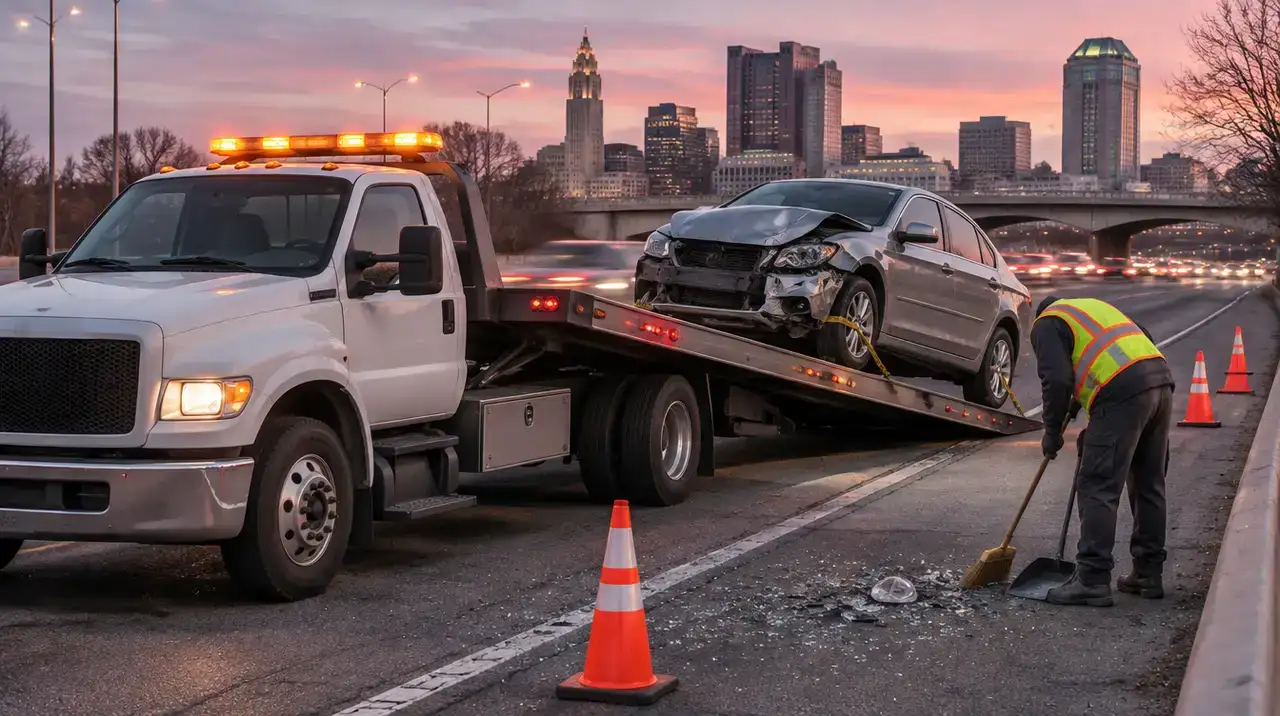
There is a bang louder than the crash itself, a white cloud, a sharp chemical smell, and a limp nylon bag draped over the steering wheel. Airbags fire in a fraction of a second, and once the dust settles most drivers ask the same thing: can I still drive this car home? The short answer is almost always no. This guide explains why, what to do in the first few minutes, what a deployment means for your insurance claim, and how our accident towing in Columbus gets the car off the road without making the damage worse.
People first, then the car
An airbag is designed to hit you hard enough to stop you from hitting something harder. That can leave burns or scrapes on the forearms, a sore chest, a bloody nose or ringing ears, even in a crash that felt minor. Take a breath and check everyone in the car, including passengers in the back seat.
Call 911 first if anyone is hurt, if you see flames or smoke that keeps building, if you smell fuel, or if the car is stopped in a live travel lane on I-270, SR-315 or a busy street like Broad Street or Morse Road. A tow can wait; none of those can.
That cloud is usually not a fire
The haze that fills the cabin right after a deployment is mostly fine powder and gas from the inflation. It looks alarming, and it can sting your eyes, throat and skin, but it is not the car burning. When it is safe to do so, open a window or step out on the side away from traffic to get fresh air, and rinse your face and hands with water when you can. Anyone with asthma may feel it more, so get them to clean air quickly.
What is different is smoke that keeps getting thicker, coming from under the hood or the dash, or a smell of burning plastic or gasoline. In that case, get everyone well away from the car and call 911.
What actually happens when airbags go off
A deployment is not just the bag you can see. In a typical modern car, a crash sensor tells the airbag control module to fire one or more bags, and the same signal often tightens the front seat belts with pretensioners so they lock you in place. Depending on the car and the crash, that can include the steering-wheel bag, the passenger bag in the dash, knee bags, seat-mounted side bags and curtain bags along the roof line.
Every one of those parts works once. After it fires, it is spent. Many cars also respond to a deployment by shutting off the fuel pump, unlocking the doors or switching on the hazard lights, and some will not restart normally until a shop resets or replaces the parts involved. The red airbag or SRS light on the dash usually stays on afterward to tell you the system is no longer ready.
Why a car with deployed airbags should be towed
- No protection in a second crash. A spent bag cannot inflate again, and belts whose pretensioners have fired may not hold you the way they did the first time. The drive home is exactly when a tired, shaken driver is most likely to have a second scrape.
- The impact was hard. Airbags fire when the sensors read a serious jolt. A crash that strong often bends suspension parts, cracks the radiator or damages wiring behind the bumper, even when the outside looks tidy.
- You may not be able to see or steer well. A deflated bag hangs over the wheel and the horn, the dash may have opened up in front of the passenger, and powder can coat the inside of the windshield.
- The car may quit on you. A car that restarts on the shoulder can still stall on a ramp if a fuel cut-off or a damaged sensor kicks in, which turns one roadside stop into two.
If an officer at the scene tells you to roll the car a short distance out of a lane, do what the officer says. That is different from driving it across town. For other kinds of damage, like leaks, a crooked wheel or warning lights, our checklist on whether a car is safe to drive after an accident walks through each one.
Leave the airbags alone
It is tempting to stuff the bag back into the wheel or cut it away so you can see. Do not. A deployed airbag cannot be repacked, the parts around it can stay hot for a few minutes, and pulling or cutting at it can damage wiring the shop will need. The bags are also evidence: they show the adjuster how hard the car was hit and which systems fired.
Photos and notes for the claim
From a safe spot, and only once everyone is okay, take pictures of:
- each deployed airbag, including side and curtain bags you might not notice at first;
- the dashboard with the ignition on, so the warning lights show;
- the outside damage from several angles, plus a wide shot that shows where the car ended up;
- the other car, its plate and the other driver's insurance card, if another car was involved.
When you open the claim, tell your insurer plainly that the airbags deployed. Airbag replacement is a big repair item, and the adjuster uses it to decide whether the car will be repaired or reviewed as a total loss. That decision is the adjuster's, not ours, so keep the car as it is until they have seen it. Write down the claim number; it is the first thing dispatch will ask for.
Before the car is loaded, take out your wallet, phone charger, garage opener, medication and anything else you will need for the next few days. If there is a child safety seat in the car, check the seat's manual and ask your insurer about it before using it again, because many manufacturers say to replace a seat that was in a crash.
If police are at the scene
An officer working the crash decides when each car can leave and, in some situations, how a car that cannot be driven gets moved. Tell them the airbags deployed and that you do not plan to drive it. Our guide to police-called tows after a crash in Columbus explains when you can pick the tow company and when the officer calls one. We respond to crash scenes 24/7; when the officer allows you to choose, you can request us at (740) 812-9489.
What to tell dispatch
- Where you are: the road, your direction, and the last exit, cross street or business you passed. You can also send a map pin from the SOS request page.
- That the airbags deployed, and whether the car still rolls and steers.
- The car: year, make and model, and whether it is electric, hybrid or all-wheel drive.
- Where it should go: your body shop if you have one, or our lot to wait for the insurer.
Arrival times are estimates, never a promise: most metro calls are reached in 20–40 minutes and outer communities in 40–60. On the west side, including Hilliard and Upper Arlington, it is usually 15–30 minutes. While you wait, stay buckled in with the hazards on if you are on a busy shoulder, or wait well away from traffic behind a guardrail.
How we tow a car after an airbag deployment
A crash hard enough to fire the airbags usually means the car rides on a flatbed, so none of its wheels have to turn on the way. All-wheel-drive cars should never be towed with two wheels on the road, and electric cars and hybrids travel with all four wheels off the ground, on a flatbed or on a wheel-lift with dollies as the manufacturer allows; see EV and Tesla towing. A damaged EV also needs to be stored away from other cars, which our post on EV storage safety at tow yards explains.
Once the car is loaded, our driver sweeps up the broken glass, plastic and parts that came off it and puts absorbent on small drips it left behind. If you already have a body shop, we can take the car straight there. If you do not, it usually goes to our storage lot at 1620 Harrisburg Pike to wait for the insurer's instructions, and dispatch can route it to a collision shop in our auto repair partner network.
What it costs and who pays
On accident tows we bill your insurer, so the claim number matters more than a credit card. For reference, a standard tow with us runs a $125 hookup and $7 for each mile on the truck. Our lot charges $45 a day, counted from the day of the tow. Veterans who show a military or VA ID save 10%. The full rate card, with after-hours and weekend charges, is on the pricing page, and you hear the price from dispatch before anything is hooked up. Because storage is daily, the sooner the adjuster sees the car and names a shop, the fewer days end up on the bill. Our post on who pays for the tow after a crash in Ohio covers the insurance side in more depth.
Before you drive it again
If the car is repaired rather than totaled, the shop should replace every airbag that fired along with the other parts the repair calls for, which often include the seat belts that locked and the control module. When you pick it up, start the car and confirm the airbag light comes on briefly and then goes out. If it stays lit, the system is not ready, and the car should go back before you rely on it.
For everything else about how we handle a wreck, from the scene to the body shop, see our accident and collision towing page.
Frequently asked questions
Can I drive my car after the airbags deploy?
In almost every case, no. Spent airbags give no protection in a second impact, the seat belts may have locked, and a crash hard enough to fire the bags has often damaged parts you cannot see. Some cars also will not run normally after a deployment. Have it towed to your lot or body shop instead.
Is the smoke after an airbag deploys dangerous?
The cloud you see right after a deployment is usually fine powder and gas from the inflation, not a fire. It can sting the eyes, throat and skin, so open a window or step out to fresh air when it is safe and rinse your skin and eyes with water. If you see flames, smell burning plastic or fuel, or the smoke keeps building, get everyone away from the car and call 911.
Does an airbag deployment mean my car is totaled?
Not automatically. Replacing the airbags and the parts that fire with them is a major repair item, so a deployment can push a claim toward a total-loss review, but the insurance adjuster decides after looking at the whole car. Tell your insurer the airbags deployed when you open the claim and keep the car as it is until the adjuster has seen it.
Can I just push the airbag back in or cut it off and drive home?
No. A deployed airbag cannot be repacked, and cutting or pulling at it can damage wiring and leave you with no working airbag on the drive. The car still needs the airbag system repaired by a shop before it is safe to drive. Leave the bags as they are; they also help the adjuster see what happened.
About this guide: it is general safety and car-care guidance, not a mechanic's inspection or insurance advice. Your owner's manual, your insurer and a qualified repair shop have the final word on your car and your claim. This post is general information, not legal advice.
Airbags went off and the car should not move? If anyone is hurt or a car is in a lane, call 911 first. Otherwise call (740) 812-9489 any hour, or send your location from the SOS request page.