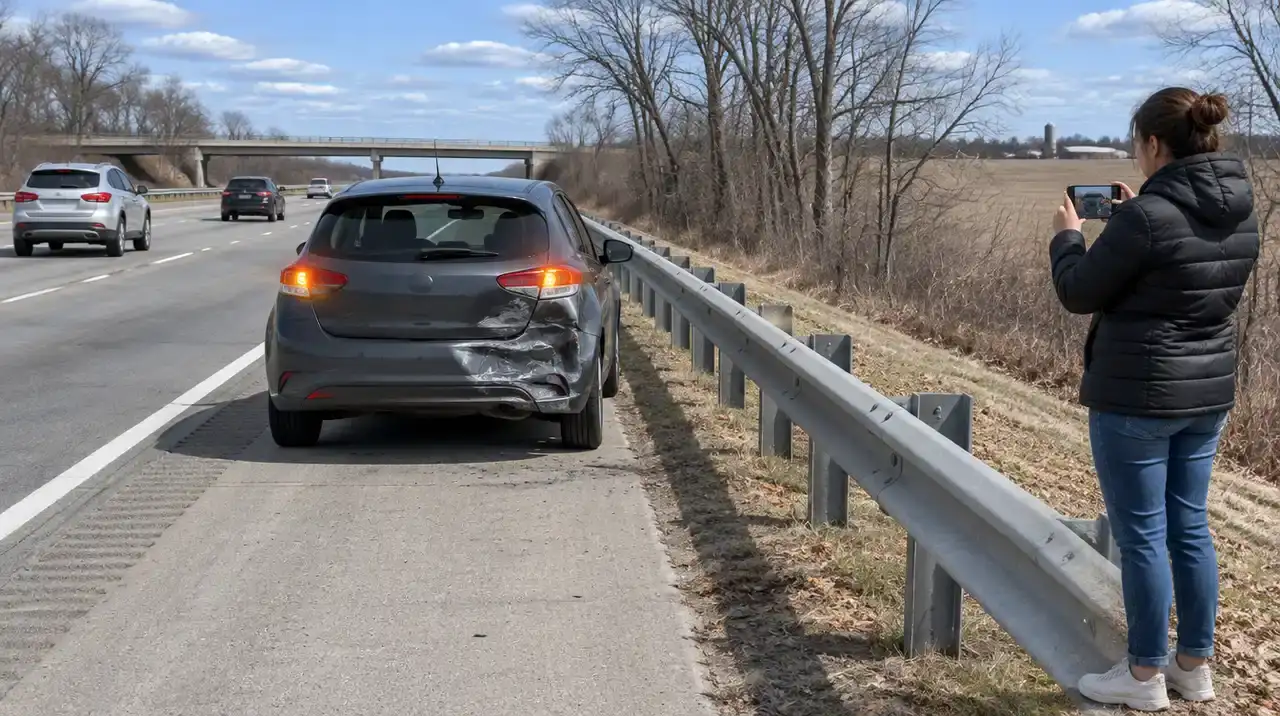
After a fender bender the car often looks almost fine: a scuffed bumper, a cracked lens, maybe a hood that sits a little crooked. The engine still runs, and the tempting move is to drive home and deal with it tomorrow. Sometimes that is the right call. Other times the damage you cannot see, a pushed-back wheel, a cracked radiator or a brake line that took a hit, turns a short drive into a second emergency. This checklist helps you decide on the spot, and when the answer is "do not drive it," our accident towing in Columbus takes it from there.
First, rule out the emergencies
Call 911 first if anyone is hurt, if you see smoke or flames, if fluid is pouring rather than dripping, if you smell gasoline strongly, or if a car is stopped in a live travel lane. Do not start or restart a car that smells of fuel or is smoking. A tow can wait; nobody should stand beside a wrecked car on the traffic side of I-270 or SR-315 to save twenty minutes.
Look the car over from a safe spot
If nobody is hurt and the car moved under its own power, get it out of traffic before you inspect it: the right shoulder, the end of an exit ramp, or a side street off Broad Street or Morse Road. Hazards on. On a freeway shoulder, do the walk-around from the side away from traffic, or stay behind the guardrail and look from there. A phone flashlight helps after dark.
Take photos as you go; they help the insurance claim later. Our step-by-step post on what to do after a crash on a Columbus freeway covers the scene itself; this one is only about the car.
The walk-around: six things that mean "tow it"
- Fluid under the car. Look at the pavement under the engine and each wheel. Green, orange or pink liquid is usually coolant from a damaged radiator, which can overheat the engine within a few miles. Red can be transmission or power-steering fluid. Brown or black is often engine oil. A wet spot near a wheel can be brake fluid, and that alone is reason not to drive. Clear water dripping near the front passenger footwell on a warm day is usually just air-conditioning condensation.
- A wheel that sits wrong. Stand in front of the car and compare the two front wheels, then the rear pair. A wheel that leans in or out at the top, sits further back in its opening than the other side, or points a different direction from its partner usually means a bent suspension or steering part. That car should not be driven at all, even across a parking lot.
- Tires and rims. Check for a flat or low tire, a bubble or cut in the sidewall, a rim with a dent or crack, and body panels or the plastic wheel-well liner pushed against the tire. Anything rubbing a tire will wear through it.
- Lights. Turn on the headlights, flashers and turn signals, then have someone press the brake while you look at the back. A car with no working headlight or brake light on one side is hard for other drivers to see, especially at night or in rain.
- The hood, trunk and doors. A hood that will not latch can fly up at speed and cover the windshield. Doors or a hatch that will not close fully should not be held shut with a bungee for a highway drive.
- Anything hanging or dragging. A bumper cover, undertray or splash shield hanging low can catch on the road and tear loose. If it is dragging and you cannot secure it, that is a tow.
Start it and read the dashboard
If the walk-around looks clean, start the car and watch the dash for a minute. Red warning lights are the ones that mean stop:
- Temperature or coolant warning, or a gauge that climbs: the cooling system is damaged. Turn it off.
- Oil pressure warning: turn the engine off right away.
- Brake warning: do not drive until the brakes are checked.
- Airbag (SRS) light: the airbag system may not work in a second crash. Get it to a shop.
- Charging or steering warnings: the car may lose power steering or die on the road, often at the worst moment.
If the airbags went off
Deployed airbags are a sign the impact was hard enough to have damaged parts you cannot see, and the deployed bags will not protect you again until they are replaced. The fabric and dust also hang in the cabin and can block your view. Some cars shut off fuel or will not restart normally after a deployment. Our advice is simple: when the airbags have deployed, have the car towed rather than driven.
A slow test before the road
If the car passed everything so far, drive it slowly across the parking lot or down a quiet side street before you merge anywhere. Pay attention to:
- a steering wheel that sits off-center when the car goes straight, or a pull to one side;
- grinding, scraping or clunking, especially when you turn;
- vibration that grows with speed;
- a brake pedal that feels soft, sinks toward the floor or needs more push than usual.
Any of these means the car should not go onto US-33 or the outerbelt. Even if it feels fine, take the shortest, slowest route home or to a body shop.
Electric, hybrid and all-wheel-drive cars
Electric cars and hybrids carry a large battery under the floor. If the crash involved hitting a curb hard, bottoming out, or damage low on the car, treat it as undrivable even if the dash looks normal, and keep everyone away from it if you notice smoke, hissing or popping. A damaged EV should travel with all four wheels off the ground, either on a flatbed or on a wheel-lift with dollies, following the manufacturer's guidance; see our EV and Tesla towing page. A damaged EV also needs care after the tow, and our post on EV storage safety at tow yards explains why.
All-wheel-drive and four-wheel-drive cars should not be towed with two wheels on the road, because that can damage the drivetrain. Tell dispatch it is AWD and we will send flatbed towing or use dollies.
When police are at the scene
If an officer is working the crash, tell them honestly what you found: leaks, warning lights, a wheel that looks wrong. The officer decides when each car can leave, and in some cases decides how a car that cannot be driven gets moved. Our guide to police-called tows after a crash in Columbus explains when the driver picks the tow company and when the officer does. We respond to crash scenes 24/7; when the officer allows you to choose, you can request us at (740) 812-9489.
If you decide to tow: what to expect
Tell dispatch where you are, the car, whether it rolls and steers, and where it should go. Response times are estimates, never a promise: most metro calls, including Reynoldsburg and Dublin, are reached in 20–40 minutes, outer communities in 40–60, and the west and southwest side, like Grove City, usually 15–30.
On accident tows we bill your insurer, so have the claim number ready if you have one. Unless you name a shop, the car usually goes to our storage lot at 1620 Harrisburg Pike until the insurer says where it should go. Storage starts the day of the tow, so if you already have a body shop, going straight there saves a second move and those days. If you need a shop, dispatch can route the car to one in our auto repair partner network. Our standard rate is $125 to hook up plus $7 per mile towed, storage is $45 per day, and veterans get 10% off with a military or VA ID. The full list is on our pricing page, and dispatch quotes the price before hookup. For more on keeping storage days down, read towing and storage fees after an accident.
Before leaving, our driver clears the broken glass, plastic and parts that came off your car and puts absorbent on small drips from it. Everything else about how we handle a wreck is on our accident and collision towing page.
Frequently asked questions
How do I know if my car is safe to drive after an accident?
Check for fluid under the car, a wheel that leans or sits back in its opening, damaged tires, working headlights and brake lights, and a hood and doors that latch. Then start it and watch for red warning lights such as temperature, oil pressure or brakes. If any of those fail, or you are unsure, have it towed.
Can I drive my car if the airbags deployed?
It is better not to. A deployment means the impact was hard enough to damage parts you cannot see, the deployed bags will not protect you again until they are replaced, and some cars will not restart normally afterward. Have the car towed to a shop or to storage while the claim is sorted out.
Is it safe to drive a car that is leaking fluid after a crash?
Usually not. Coolant (green, orange or pink) can mean a damaged radiator that will overheat the engine, and fluid near a wheel can be brake fluid. Clear water near the front passenger side on a warm day is often just air-conditioning condensation. If you smell gasoline, do not start the car and call 911.
My car drives after a minor accident but pulls to one side. Is that okay?
A pull, an off-center steering wheel or a new vibration after a crash usually means bent steering or suspension parts or a damaged wheel. Keep it off the freeway, take the shortest slow route to a shop if you drive at all, or have it towed.
Can you tow my car straight to a body shop after an accident?
Yes. Tell dispatch the shop's name and address and we take the car there directly, which avoids a second move. If you do not have a shop yet, the car can go to our lot at 1620 Harrisburg Pike to wait for the insurer's instructions.
About this guide: it is general safety and car-care guidance, not a mechanic's inspection. Your owner's manual and a qualified repair shop have the final word on your car.
Not sure the car should move? If anyone is hurt or a car is in a lane, call 911 first. Otherwise call (740) 812-9489 any hour, or send your location from the SOS request page.