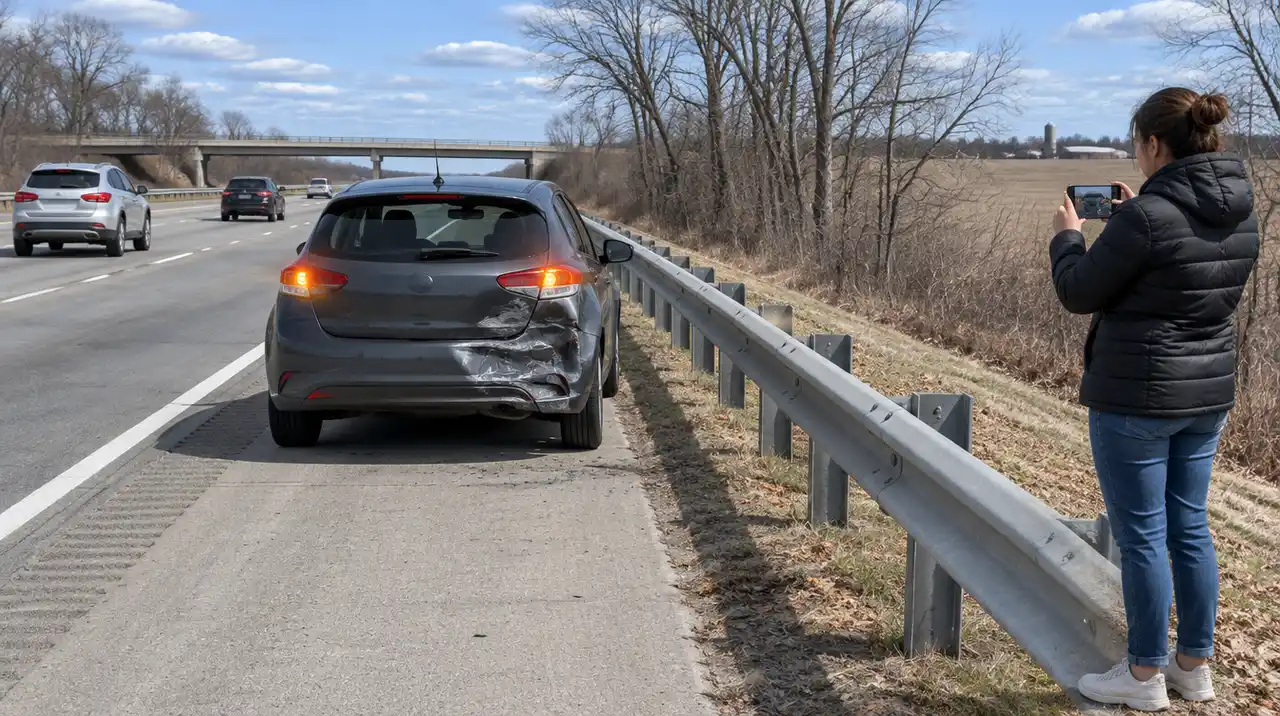
A crash on a Columbus freeway happens fast and then slows to a crawl: the bang, the shoulder, the hazard lights, and a long list of things you are supposed to remember while traffic roars past at highway speed. This is the order we would want a family member to follow after a wreck on I-270, I-70, I-71 or SR-315, from the first minute to the day the car reaches a body shop. When the car cannot be driven, our accident towing service in Columbus handles the tow, picks up the vehicle debris and bills your insurer.
Every rule mentioned below links to the official source it comes from. This post is general information, not legal advice, and the officer at your scene always has the final word.
Step 1: Check for injuries and call 911 when it is an emergency
If anyone is hurt, if there is smoke or fire, or if a car is stopped in a travel lane, call 911 before anything else. Everything else on this list can wait. Tell the dispatcher the highway, your direction, and the last exit or mile marker you remember.
For a breakdown or a minor problem on an Ohio highway, the State Highway Patrol's help center lists #677 to reach the Patrol and 911 for local police. Freeways inside Columbus are often worked by the Patrol, while city streets are worked by the Columbus Division of Police, and suburbs have their own departments.
Step 2: Get out of the flow of traffic if the car can move
Most freeway crashes are fender benders, and the second crash, a car hitting people standing beside the first one, is the one to fear. The Ohio Department of Public Safety's Digest of Ohio Motor Vehicle Laws says that in minor crashes, if it is possible and safe, you should remove your vehicle from the flow of traffic, and that after a crash you should move the vehicle off the roadway as far as possible. That is state guidance rather than a statute, but it is the right call.
- Steer onto the right shoulder, or the nearest exit ramp if it is right there, and turn on your hazards.
- Do not stand between cars or in the gap between your car and the guardrail on the traffic side.
- The Patrol's advice for a car stopped on the shoulder is to stay with it with the safety belt on. If you have to get out, go behind the guardrail, well away from traffic.
- If the car will not move, leave it where it is, hazards on, and tell 911 it is in a lane.
Step 3: Exchange the information Ohio law requires
Ohio Revised Code 4549.02 requires every driver in a crash to stop and stay at the scene until they have given their name and address, the owner's name and address if they do not own the car, and the vehicle's registration number to the other driver, anyone injured and the police officer at the scene. Leaving without doing it is a crime under that section.
On a freeway shoulder, do the exchange by phone photo where you can: a picture of the other driver's license, registration and insurance card is faster and more accurate than writing it down with trucks going by. Add the other car's plate and a wide shot that shows both cars and the lane markings.
Step 4: Tell the officer whether the car can be driven
When police arrive, the officer secures the scene, takes statements and decides whether each car can leave under its own power. Be honest about warning lights, leaking fluid, a wheel that is pushed back, or headlights and taillights that no longer work. A car that limps off the shoulder and dies on the ramp creates a second emergency.
If the car cannot be driven, the next question is who tows it. On Columbus police scenes, the Division's own Directive 6.01 tells officers to let an owner or operator who is present arrange a private towing company when there is no legal need to impound the car and the company can respond without unnecessary delay or a safety concern. A wreck that is blocking freeway lanes, a driver who is hurt or arrested, or a car that must be impounded changes that, and the officer calls the wrecker. Our guide to police-called tows after a crash in Columbus explains both cases in detail.
Step 5: If you can choose the tow, call and give the officer an ETA
We respond to crash scenes 24/7; when the officer allows you to choose, you can request us at (740) 812-9489. Give the dispatcher what a truck needs to find you on a freeway:
- Highway and direction. Downtown, I-70 and I-71 run on the same lanes between the split interchanges, so say which direction you were driving and the last exit or street you passed.
- Exits on both sides of you. On the I-270 outerbelt, the last exit you passed and the next one ahead tell the driver which side of the loop you are on. Our page on a breakdown on I-270 lists the interchanges.
- The nearest landmark. On SR-315, the I-670 ramps, the Ohio State stretch or the nearest cross street; see towing on SR-315.
- The car. Year, make and model, whether it rolls and steers, and whether it is electric or all-wheel drive. EVs ride with all four wheels off the ground, on a flatbed or a wheel-lift with dollies as the manufacturer allows; see EV towing.
- Where it should go. Our lot to wait for the insurer, or your body shop.
Pass the ETA to the officer. Response times are estimates: most metro calls are reached in 20–40 minutes and outer communities in 40–60, and on the southwest side, including Grove City, usually 15–30. The officer can still decide the scene cannot wait.
Step 6: Let other drivers move over for the people working
Once the truck is there, the shoulder becomes a work zone. Ohio's Move Over law, ORC 4511.213, tells drivers approaching a stopped emergency, road service or highway maintenance vehicle with flashing lights to change to a lane that is not next to it when they safely can, and otherwise to slow down and proceed with due caution. Road service vehicles include wreckers. You cannot control other drivers, but you can stay well away from the traffic side while the car is loaded.
Before leaving, our driver sweeps up the glass, plastic and loose parts that came off the vehicle we are towing. Bigger spills and anything hazardous belong to the responders the officer calls.
Step 7: Get the report number and open the claim (and empty the car)
Ask the officer or trooper for the crash report number before you leave, and take your wallet, keys, child seats and medication out of the car, because it may sit for days. The City of Columbus Find an Accident Report page says Columbus police crash reports are submitted to the Ohio Department of Public Safety, where copies obtained through the ODPS website are free; the ODPS crash retrieval site searches them by report number or by date, county and agency. For a Highway Patrol crash, the Patrol's help center says reports are ordered online from the Patrol.
Open the insurance claim the same day if you can. The claim number is what lets the towing bill go to the insurer instead of to you. On accident tows, we bill the insurer: give us the claim number and the adjuster's name and phone number as soon as you have them. If you are wondering who ends up paying, our post on who pays for the tow after a crash in Ohio walks through it.
Step 8: Move the car once, to the right place
Most of our accident tows go to our lot at 1620 Harrisburg Pike to wait for the insurer's instructions, and storage there starts the day of the tow. If you already have a body shop, we can take the car straight there and skip the second move. The Ohio Department of Insurance's Automobile Insurance Guide says you can have your car repaired wherever you choose unless your policy language says otherwise, and our dispatcher can route it to a collision shop in our auto repair partner network if you do not have one. The full list of what happens after the tow is on our accident and collision towing page.
Frequently asked questions
What should I do first after a car accident on a Columbus freeway?
Check for injuries and call 911 if anyone is hurt, there is fire, or a car is stopped in a travel lane. If the cars can move and nobody is hurt, Ohio's Digest of Motor Vehicle Laws advises moving out of the flow of traffic when it is safe. Then turn on your hazards and stay belted in or behind the guardrail.
Do I have to stay at the scene of a minor crash in Ohio?
Yes. Ohio Revised Code 4549.02 requires drivers to stop and remain at the scene until they have given their name and address, the owner's name and address if different, and the vehicle's registration number to the other driver, anyone injured and the police officer at the scene.
Can I pick my own tow truck after a crash in Columbus?
Often. Columbus Division of Police Directive 6.01 tells officers to let an owner or operator at the scene arrange a private tow company when there is no legal need to impound the car and the company can arrive without unnecessary delay or a safety concern. If the car must be impounded or is an immediate hazard, the officer calls the wrecker.
How do I get a crash report after a freeway accident?
Ask the officer for the report number. Columbus police crash reports go to the Ohio Department of Public Safety, where copies are free online, and Highway Patrol reports are ordered from the Patrol's online records request. Crashes handled by a suburban department are requested from that department.
Sources, opened November 6, 2026: Ohio Revised Code 4549.02 and 4511.213; ODPS Digest of Ohio Motor Vehicle Laws, Section 10; Ohio State Highway Patrol help center; Columbus Division of Police Directive 6.01; City of Columbus Find an Accident Report; Ohio Department of Insurance Automobile Insurance Guide. This post is general information, not legal advice.
In a crash right now? If anyone is hurt or a car is in a lane, call 911 first. When the scene is safe and the officer lets you choose, call (740) 812-9489 or send your location from the SOS request page.