Low Profile Towing in Columbus, OH for Lowered Cars, Sports Cars and EVs
Low profile towing in Columbus for cars that sit close to the pavement: lowered builds, sports and exotic cars, and EVs with long, low noses. We load on a gently tilted flatbed with ramp boards at the tail, winch at walking speed and hold the car by its tires, so the splitter, skirts and battery floor stay off the steel.
What Low Profile Towing Means, and Why Low Cars Scrape
Low profile towing comes down to geometry. Every car has an approach angle, the steepest slope its front end can climb before the bumper or air dam touches, and a matching departure angle at the rear. A stock sedan clears the tilted deck of a flatbed with room to spare. Drop the suspension two inches, add a front lip or side skirts, and that margin is gone: the nose meets the tail of the bed before the front tires do, and whatever plastic touches first gets scraped, cracked or pulled loose.
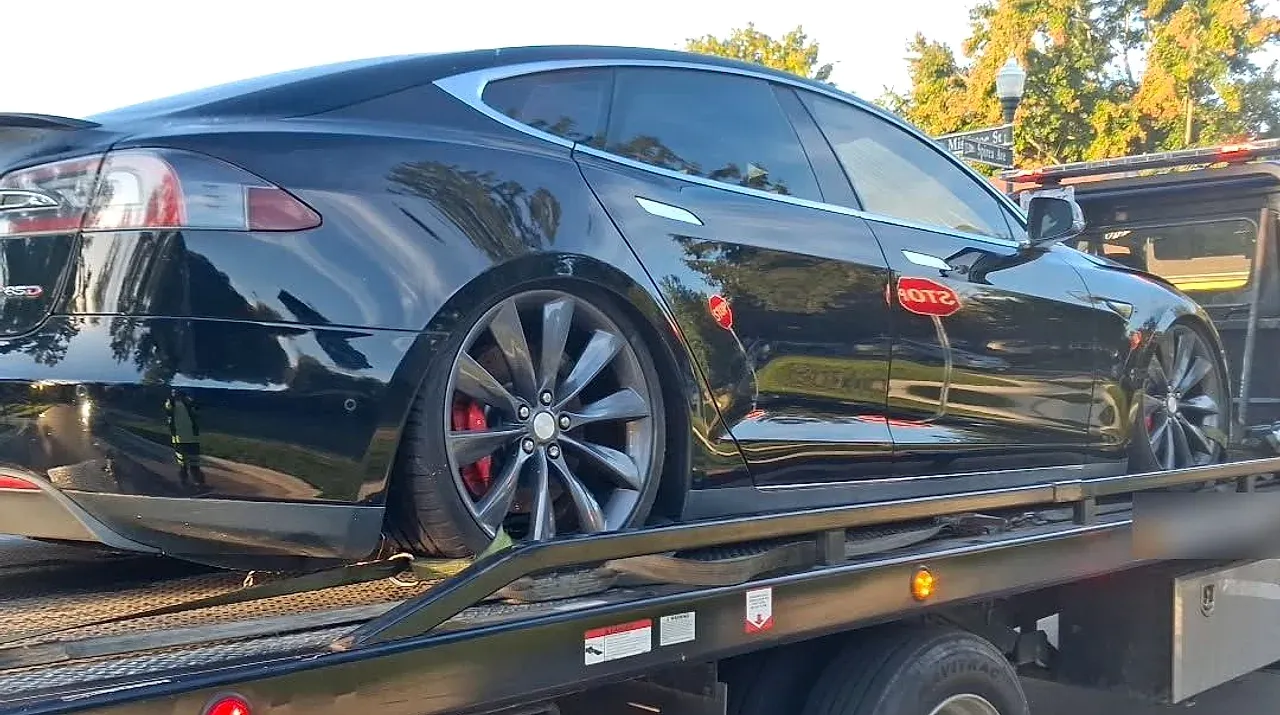
The nose is only the first pinch point. As the front wheels climb a tilted deck, the car pivots over the bed's tail edge, so the middle of the car, meaning the rocker panels and anything bolted underneath, can drag even after the bumper has cleared. Long-wheelbase cars suffer most. A Tesla Model S, with its low rocker line and a battery pack that forms the floor, needs more care than its ride height suggests.
The cars that need this treatment are easy to spot: anything on coilovers, lowering springs or air suspension; factory sports cars with deep front air dams, such as a Corvette, whose own owner's manual says the air dam and splitter have minimal ground clearance; sedans and EVs with low aero panels and side skirts; and show cars with body kits, diffusers or low exhaust tips. If you already take driveways at an angle, your car belongs on this list.
Our method is slow on purpose: lower the angle, add height where the car meets the bed, pull it up gently and hold it by its wheels. Lowered car towing is billed from the same published rate card as any other tow.
The first job is to make the slope as shallow as the truck allows. A flatbed tilts and slides its deck back until the tail rests on the ground, and the angle that results depends on the truck and on the ground under it. A driveway that rises toward the garage makes the angle steeper; a level street, or a spot where the truck's rear wheels sit a little higher than the car, makes it gentler.
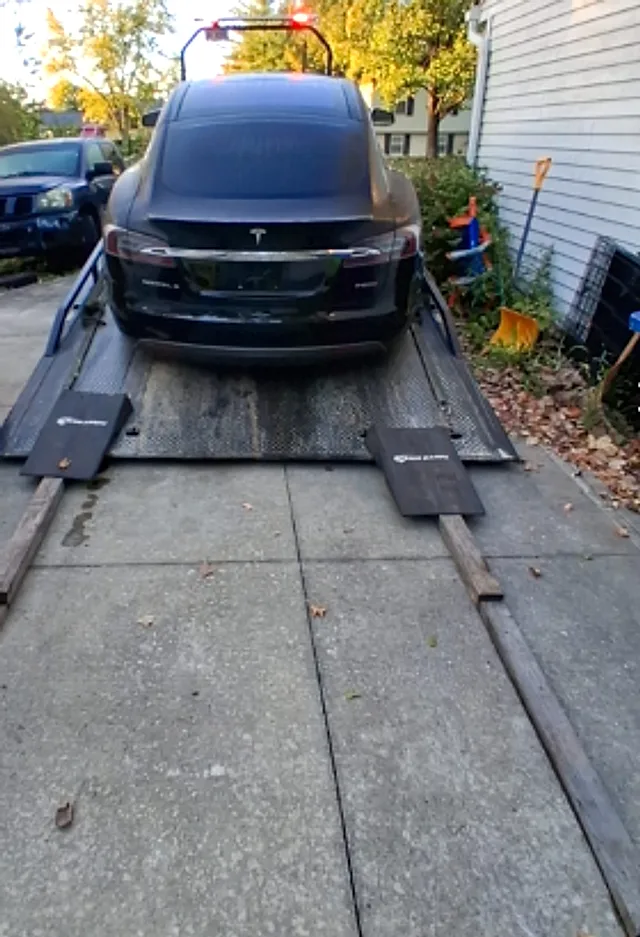
Next, we raise the car to meet the bed. Ramp boards and pads go under the front tires at the tail of the deck, so the tires climb a short, easy step before they reach the steel. Lifting the wheels a few inches at that one critical point is often enough for an air dam to pass over the edge instead of into it. Chevrolet's Corvette manual says the same thing in its own words: use ramps to help reduce approach angles when necessary.
The winch does the pulling, at walking speed or slower, while the driver watches the lowest point of the car. The cable goes to a proper attachment point, usually the threaded tow eye most modern cars carry, or a point the manufacturer names. Never a bumper cover, a lip or a suspension arm. Tesla's Model S transport instructions say to winch only from a properly installed tow eye, and warn that pulling on the chassis, frame or suspension can cause damage. If the nose gets close to the deck at any moment, the driver stops, adds another board and carries on.
Ramp boards and pads at the tail of the bed lower the approach angle, so a low car climbs onto the deck without scraping its nose or rockers.
Held by the tires: soft straps instead of hooks
Once the car is on the bed it has to stay put, and on a low car the tie-down points matter as much as the loading. Chains hooked to a control arm or a subframe pull down on parts never meant to carry that load.
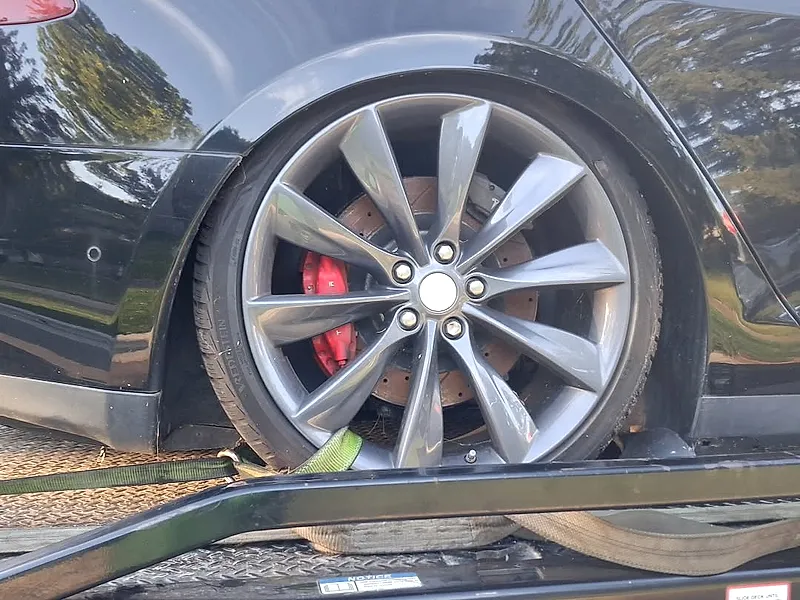
So we strap the wheels. A soft strap wraps the tire and ratchets down to the deck, holding the car through the rubber instead of through the body or the suspension. The car rides at its own height, the suspension stays free to move, and nothing presses on the paint. Chevrolet's manual gives the same instruction: use proper tire straps, and do not strap or hook to any frame, underbody or suspension component it does not specify.
Air suspension adds one step. Tesla's Model S manual says its air suspension self-levels even with the power off, and tells transporters to raise the car to Very High and turn on Jack mode before transport, so the car does not try to re-level while it is strapped down. Aftermarket bag setups vary, so we ask about them on the phone.
A soft strap holds the car by its tire. Nothing is hooked to the body, the wheel spokes or the suspension.
Low-clearance EVs: four wheels up, two ways
Many of the lowest cars on Columbus roads today are electric, with the battery under the floor and a nose shaped for range rather than ramps. That means two rules at once: the car must not scrape, and it must travel with all four wheels off the ground, because an EV's motor turns whenever its wheels do.
As with every EV we move, either method works. A flatbed with ramp boards suits a car that rolls freely and has room around it. A wheel-lift with dollies is often the better choice in a tight spot, and Tesla's Model S instructions list wheel lifts and dollies as an approved way to transport the car with every tire off the pavement. The lift cradles the tires, not the bumper, so it stays clear of a low front fascia.
A dead EV's parking lock keeps its wheels from turning, so the car goes onto dollies or skates unless a 12V jump wakes it enough for transport mode. The full routine is on our EV and Tesla towing page.
What to tell dispatch about a low car
Two minutes of detail saves a second trip. When you call (740) 812-9489, have these ready:
Year, make, model and trim. The base sedan and the performance version of the same car can sit at very different heights.
Any lowering: springs, coilovers, air suspension or bags, and roughly how far below stock the car sits.
Low-hanging parts: front lip or splitter, side skirts, rear diffuser, a low exhaust or an aftermarket body kit.
Whether it runs, steers and rolls. A car that can creep onto the bed under its own power loads differently from one that must be winched, and locked wheels call for dollies or skates.
Where it sits: a flat street, a sloped driveway, a lot with speed bumps, or a garage level with a posted clearance.
Whether the car has a front-lift or ride-height setting, and whether it has power to use it.
Low cars in low garages
Columbus parking structures sometimes combine both kinds of low: a low car under a low ceiling. A flatbed rarely fits under a garage's clearance bar, so a compact low-clearance wheel-lift unit goes in, picks the car up by its tires (on dollies if it is AWD or electric) and brings it down to the street, taking each ramp crest slowly so a center skirt does not catch. The garage side of this work is covered on our parking garage recovery page, and general bed work on our flatbed towing page.
Low profile towing around Columbus
Some low-car calls start with the roads themselves. Columbus has plenty that are hard on a lowered car: the brick streets of German Village and other older neighborhoods, steep driveway aprons, speed humps in apartment complexes and the potholes that open every late winter. A torn undertray after a pothole is a common reason a low car can no longer be driven.
Car shows bring the rest. The Goodguys Summit Racing Nationals fill the Ohio Expo Center every July with hot rods, customs and low-slung builds, and a car that overheats or breaks a part there needs the same unhurried loading as one that fails on the street. Most metro calls are reached in 20 to 40 minutes and outer communities in 40 to 60, starting from our yard at 1620 Harrisburg Pike.
Drop-off is wherever you choose, from your own garage to a dealer, a body shop or the Tesla Service Center on Easton Loop West. If the destination has a steep entrance, say so, and the driver will unload on level ground nearby.
Key features
Low-Angle Loading: The truck is positioned so the ground works for the angle, and the deck is tilted and slid back until its tail sits flat on the pavement.
Ramp Boards at the Tail: Boards and pads under the front tires raise the car exactly where the bed meets the road, which is where a low nose usually hits.
Walking-Speed Winch: The car comes up slowly from a tow eye or a manufacturer-named point while the driver keeps an eye on its lowest edge.
Soft Wheel Straps: Tie-downs wrap the tires, never control arms or the frame, so the car is held by its wheels and its suspension stays free.
Wheel-Lift With Dollies: For tight spots, garages and many EVs, a wheel-lift cradles one axle by the tires and dollies carry the other, with no bumper contact.
Air-Ride Aware: We follow the maker's air suspension steps, such as raising a Model S to its highest setting and enabling Jack mode, before strapping down.
Why choose Roadside Towing & Recovery Inc
We slow down for low cars, and the driver budgets the extra loading time instead of rushing the angle.
Ramp boards, pads, dollies and skates ride along, so the answer to a tight clearance is already on the truck.
Every low car is secured by its tires: no hooks on bumpers, lips or suspension arms, and no chains across the bodywork.
Published pricing with no low-clearance surcharge: a low-profile job is billed as a standard tow, and an EV on the EV rate card.
Insured, with PUCO towing certificate #650256 and USDOT #03560921, dispatching from our yard at 1620 Harrisburg Pike.
How it works
Describe the Car: Call (740) 812-9489 with the year, make and model, any lowering or air suspension, the parts that hang low, and whether the car runs and rolls.
Choose the Spot and the Method: On arrival the driver walks around the car, finds its lowest points, picks a flatbed with ramp boards or a wheel-lift with dollies, and sets the truck on the flattest approach available.
Load at a Crawl: Boards go down at the tail, the winch line clips to the tow eye, and the car climbs slowly, with a stop whenever the nose, rockers or diffuser come close to steel.
Strap, Carry, Unload: Soft straps go over the tires, the car rides to your destination, and it comes off the bed just as slowly with the boards back in place.
Frequently asked questions
What is low profile towing?
It is towing a car that sits close to the ground without scraping it. On our trucks that means a shallow loading angle, ramp boards under the front tires at the tail of the flatbed, a slow winch pull from a proper tow point and soft straps over the tires. It is different from the low-clearance trucks we send into parking garages: this is about the car's clearance, not the ceiling's.
My car is on coilovers and sits about three inches low. Can it go on a flatbed without scraping?
In most cases, yes. The driver eases the angle by choosing where the truck parks, stacks ramp boards at the tail so the front tires lift before the lip reaches the edge, and winches slowly while watching under the nose. On a very low car, a second set of boards goes under the tires as it climbs so the rockers clear the edge as well. Mention the drop and the front lip when you call so the driver brings enough boards.
Will you hook my lowered car by the bumper?
No. A bumper cover is plastic held on with clips, and a front lip or splitter is even more fragile. The winch pulls from the car's threaded tow eye or another point the manufacturer names, and once the car is on the bed it is held by soft straps over the tires. If you cannot find the tow eye, look in the trunk or around the spare-tire well, where many manufacturers store it, and tell dispatch if it is missing.
Can you tow a lowered Tesla or another low EV?
Yes, with all four wheels off the ground, on a flatbed with ramp boards or on a wheel-lift with dollies. For a Model S with air suspension, Tesla's manual says to raise the car to Very High and enable Jack mode before transport, so if the car has power we do that first. If it is dead, the parking lock keeps the wheels from turning and the car goes onto dollies or skates, unless a 12V jump wakes it enough for transport mode.
My car has air suspension and it is completely dead. Is that a problem?
It can be. Air suspension can settle when the system loses pressure, leaving the car lower than normal, and with no power you cannot raise it. Tell dispatch it has air ride and whether it has any power. If it wakes up, the driver raises it where the manufacturer allows; if not, extra boards, dollies or skates win back the clearance.
Does low profile towing cost more than a regular tow?
No. There is no low-clearance surcharge. A low-profile tow is billed from the standard published rate card: $4 per en-route mile from our yard, a $125 hook-up fee and $7 per loaded mile, plus the usual highway, after-hours or weekend surcharges and Ohio sales tax only when they apply. An electric car is billed on the separate EV rate card. The Pricing block on this page shows the current numbers.
Can you get my low car out of a downtown parking garage?
Yes, though usually not with a flatbed inside the structure, since most garages are too low for one. A compact low-clearance wheel-lift unit goes in, lifts the car by its tires, with dollies under the other axle if it is AWD or electric, and takes the ramps slowly so a skirt does not catch on a crest. Tell dispatch the garage name, the level and the posted clearance at the entrance.
My show car broke down at the Ohio Expo Center. Can you load it there?
Yes. Tell dispatch which gate or lot you are near, what the car is and how low it sits, and whether it is parked on pavement, gravel or grass. If the ground where it sits is soft or uneven, the driver may move it a short way to the nearest level paved spot before loading, so the bed angle stays shallow.
Low-Profile Towing across Central Ohio
Roadside Towing & Recovery Inc provides low profile towing across Columbus and Central Ohio for lowered cars, sports and exotic cars, show cars and low-clearance EVs. From Dublin and Powell to Grove City and Pickerington, the routine stays the same.
Lowered car towing is a standard tow on our published rate card, with no extra charge for the boards or the time careful loading takes. Electric vehicles are billed on the EV card.
Call (740) 812-9489 and describe the car, how far it has been dropped and anything that hangs low. Most metro calls are reached in 20 to 40 minutes, and outer communities in 40 to 60.
Pricing
$4/mi en-route + $125 hook-up + $7 per mile
Low-profile towing is billed as $4 per en-route mile (yard to pickup) + $125 hook-up + $7 per loaded mile. Highway calls +$75; after-hours (10PM–6AM) +$150; weekend +$50; large vehicle +$100. Ohio sales tax applies.
Winch-out / off-road recovery: $150 per hour. Storage: $45 per day.
Pay by cash, debit or credit card, or online by card through Stripe (3% card fee). Booking by phone adds a $35 scheduling fee that the online quote builder waives. Veterans: 10% off with a military or VA ID, applied by the driver when you show it.
These are industry-standard full retail rates. You can get our VIP customer rates by downloading our ROADSIDE app through the VIP Program.