The first hard freeze of the season is when a lot of Columbus EV owners meet a number they did not expect. The car that showed plenty of miles in October now shows far fewer in the morning, and the estimate drops faster once the heater is running on I-270. Nothing is broken. Cold weather costs an electric car real range, and the drivers who plan for it rarely end up on the shoulder.
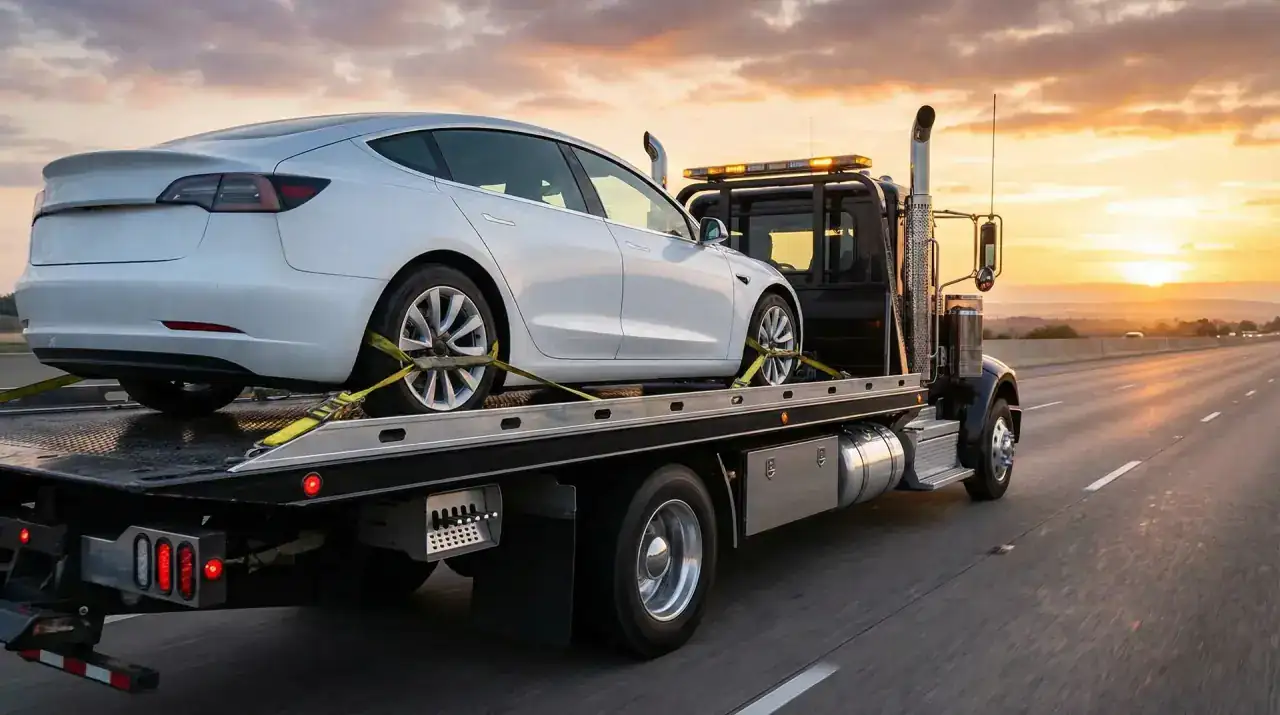
This guide covers how much range to expect to lose, why it happens, what actually helps, and what to do if the battery runs out anyway. If it does, our EV and Tesla towing moves the car with all four wheels off the ground, to a charger, your home or a dealer.
How much range does an EV lose in the cold?
Short answer: plan on losing well over a third of your range on a cold day when the heater is running. In AAA testing at 20°F, the average driving range of the electric cars tested fell 41 percent with the cabin heater on, compared with the same cars at 75°F. With the heater off, the drop was only 12 percent.
That 2019 test used five models from the 2017 and 2018 model years, run on a dynamometer in a climate-controlled room. AAA repeated the work with newer vehicles in a study published in May 2026. At 20°F, the electric vehicles in that test showed a 35.6 percent drop in efficiency and a 39 percent drop in calculated driving range. The hybrids lost about 23 percent of their fuel economy, so gas-electric cars feel the cold too.
Your own number will depend on the car, how far you drive, how warm you keep the cabin and whether the battery started out warm. Short trips are hit hardest, because the car spends more of each drive heating the battery and cabin from cold. A Central Ohio winter is full of short trips: a run from Hilliard to the grocery store, a school drop-off in Westerville, a commute down SR-315 that ends before the cabin is really warm.
Why cold weather drains an EV
Two things are happening at once. First, a lithium-ion battery is less efficient when it is cold, and the car spends energy warming it up. AAA's 2026 report points to reduced battery discharge efficiency and higher thermal-management and cabin-heating loads. Second, a gas car heats its cabin with waste heat from the engine. An EV has very little waste heat, so the warm air you feel comes out of the same battery that moves the car. The AAA numbers above show which one matters more: turning on the heater is what turns a modest loss into a big one.
A cold battery also limits what the car will do. Tesla's owner's manuals explain that a blue snowflake icon appears when some of the stored energy is unavailable because the battery is cold, and that regenerative braking, acceleration and charging rates may be limited until it warms up. So in January you may see less regen on the drive in, and a charging session that starts slower than it would in summer.
What actually helps
Precondition while you are plugged in
This is the biggest single habit. Most EVs can warm the battery and cabin before you leave, and the U.S. Department of Energy says it works best while the car is still charging, so the energy comes from the wall instead of the battery. A Department of Energy Vehicle Technologies Office analysis found that preconditioning on the charger can save up to 20 percent of battery energy on short city trips at 20°F. Tesla's app and touchscreen let you schedule it, and its manuals suggest starting climate control 30 to 45 minutes before you leave.
Use the seat and steering wheel heaters
AAA suggests seat heaters and dressing in layers instead of heating all the air in the cabin. Heating your body directly takes much less energy than heating the whole car. Turning the cabin temperature down a few degrees and using the heated seat is an easy trade on a commute down I-71.
Park inside when you can
AAA and the Department of Energy both recommend a garage or covered spot on cold nights. A car that starts the day warmer needs less energy to get comfortable. Because an EV has no tailpipe, the Department of Energy notes it can be preconditioned inside a closed garage without harmful fumes, which a gas car can never do.
Keep more charge in reserve
AAA advises keeping the battery above 50 percent in colder months, and Tesla advises leaving the car plugged in when it is not in use. In practice that means not starting a cold morning with a nearly empty battery and a plan to charge later. If you are driving farther than usual, such as US-33 to Lancaster or I-70 west past West Jefferson, check the weather first and plan an extra charging stop, as AAA recommends.
Protect the charge port
The Department of Energy warns that heavy snow or sleet can freeze a charging connector. A charge port cover helps, and so does brushing snow off the port area before you plug in.
Stuck in traffic on a cold day
A winter backup on I-270 or a closed ramp on I-670 is where a low battery gets nervous. Keeping the cabin warm while you are stopped still uses energy: the Department of Energy analysis estimated that holding the cabin temperature with the car parked at 20°F uses roughly 8 to 10 miles of range per hour. That is manageable if you started with a healthy charge, and a real problem if you were already counting on the last few miles. Lower the cabin setting, use the seat heater and keep your phone charged so you can call for help if you need it.
If you get stuck in a storm or slide off the road, the safety rules are the same as for any car: stay with the vehicle, and call 911 if anyone is hurt, if the car is in a live travel lane, or if you are in danger in a winter storm. Our winter car emergency kit guide covers what to keep in the car for exactly that wait.
What happens if your EV runs out of charge
Get safe first. Pull as far off the road as you can, turn on the hazards and stay buckled in while traffic passes. Then call (740) 812-9489 and tell the dispatcher the make, model and year, whether the screen still turns on, and where you want the car to go.
There are two different batteries in an EV, and it matters which one is dead:
- The small 12-volt battery runs the doors, screen and computers. If it is flat, the car may not wake up at all, even with plenty of charge in the main pack. A jump start to the 12-volt system can wake it, and that is sometimes all the car needs.
- The main drive battery moves the car. A jump does not recharge it. If it is empty, the car has to be towed to a charger, your home or a dealer.
Either way, an electric car should never be towed with its wheels rolling on the pavement, because a spinning wheel turns the motor. Every EV we move travels with all four wheels off the ground, on a wheel-lift with dollies or on a flatbed. A dead EV often has its parking lock engaged, so the driver uses dollies or skates unless a 12-volt jump lets the car go into transport mode. Our post on why electric cars need a flatbed or dollies walks through the manufacturer rules brand by brand, and our EV towing page explains how we load each one.
What it costs and how fast we get there
A standard tow is a $125 hook-up and $7 per loaded mile, plus en-route at $4 per mile from our yard. A jump start is a flat $75 plus en-route. Veterans get 10% off with a military or VA ID, the full rate card lists the after-hours, weekend and highway surcharges, and dispatch gives you the price before the truck rolls.
Dispatch runs around the clock across Columbus and the surrounding communities, from Dublin to Grove City. Most metro calls are reached in 20–40 minutes and outer communities in 40–60; that is an estimate, and snow days can stretch it. If the car simply needs a ride across the state or farther, we also handle long-distance towing.
Frequently asked questions
How much range does an electric car lose in cold weather?
A lot, mostly from heating. In AAA testing at 20°F, average range fell 41 percent with the cabin heater on, compared with 75°F, but only 12 percent with the heater off. A newer AAA study published in 2026 measured a 39 percent drop in calculated range at 20°F.
Does preconditioning an EV really help in winter?
Yes, if you do it while the car is plugged in. The energy to warm the battery and cabin then comes from the grid instead of the battery. A Department of Energy analysis found it can save up to 20 percent of battery energy on short city trips at 20°F.
Can a dead electric car be jump started?
Only the small 12-volt battery can be jumped, and that is often enough to wake the car so it can be put in transport mode. A jump does not recharge the main drive battery. If the drive battery is empty, the car has to be towed to a charger or home.
How should an electric car be towed in winter?
With all four wheels off the ground, every time. That means a wheel-lift with dollies or a flatbed. A dead EV often has its parking lock engaged, so the driver uses dollies or skates unless a 12-volt jump lets the car enter transport mode.
What charge level should I keep my EV at in winter?
AAA advises keeping the battery above 50 percent in colder months, and Tesla advises leaving the car plugged in when it is not in use. That leaves a cushion for heat, slower winter driving and a charger that is busy or out of service.
EV out of charge or won't wake up this winter? Call (740) 812-9489 or send your location from the SOS request page.