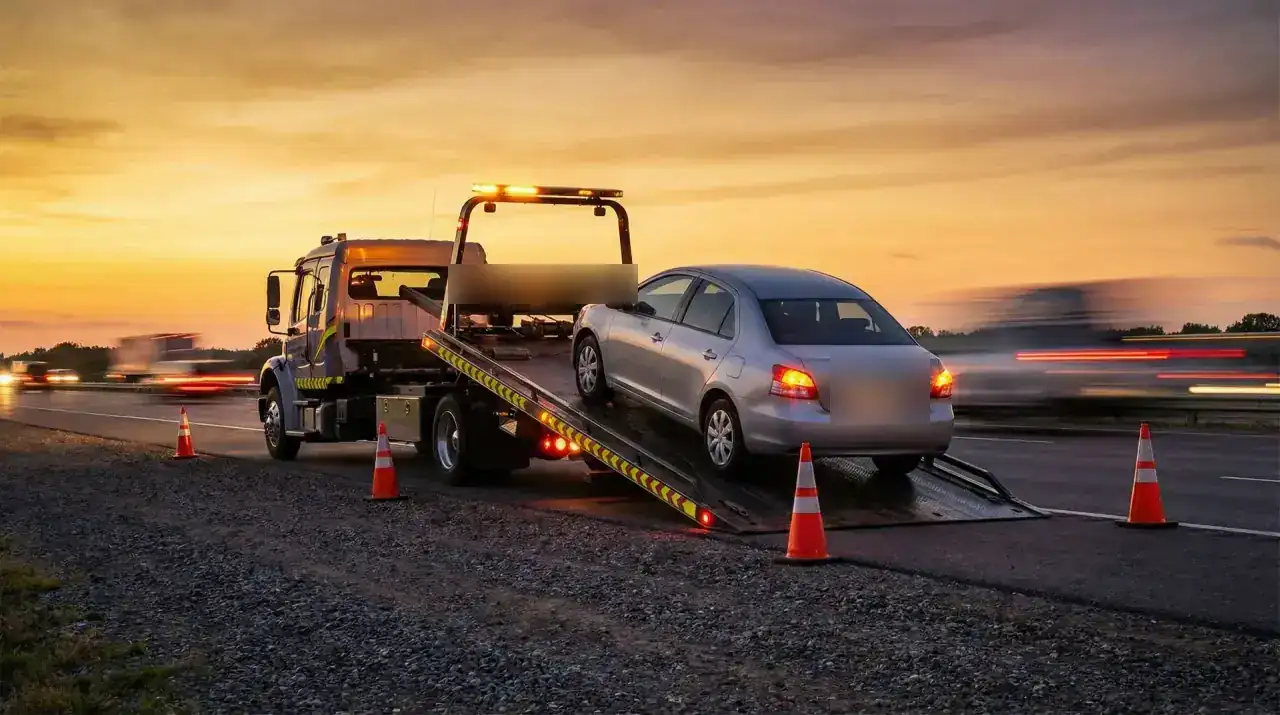
The first real snow of the season always finds Columbus drivers on the freeway. One minute the outerbelt is merely wet; the next, the left lane is slush, the ramps are glazed and someone ahead is fishtailing past a merge. Driving I-270 and I-71 in snow is not about being a hero behind the wheel. It is about space, smooth inputs and knowing where the road turns slick first. And if the car does end up stopped on the shoulder, our 24/7 emergency towing crew is a phone call away.
Here is where Columbus freeways turn slick first, the habits that keep you out of the ditch, and what to do if you slide off or break down.
Before you get on the freeway
Clear the whole car, not a porthole: windshield, windows, mirrors, lights and the roof. Roof snow slides onto the windshield the first time you brake, or blows off in a sheet onto the car behind you.
- Fuel. Leave with a healthy tank. A snowy backup can keep you idling far longer than planned, and the heater runs on that fuel.
- Washer fluid. Freeway slush becomes a gray film on the glass within minutes. Top up with winter-rated fluid.
- Phone and charger. A charged phone is how you call for help and share your location.
- A short kit. Gloves, a hat, a blanket, a scraper and a flashlight. Our winter car emergency kit guide has the full list.
Check the forecast and current road conditions before you leave. If the drive can wait until the plows have made a few passes, let it wait.
Where Columbus freeways get slick first
A few spots turn slick well before the rest of the road. Slow down before you reach them, not once you are on them.
Bridges and overpasses
A bridge deck has cold air above and below it, so it loses heat faster than pavement sitting on the ground and can ice over while the road leading up to it is only wet. The outerbelt and the routes through town, I-270, I-71, I-70 and SR-315 alike, cross rivers, creeks, rail lines and other roads again and again, and the tall flyover ramps where the interstates meet are bridges too. Ease off the gas before the bridge, keep the wheel straight and avoid braking or changing lanes on the deck itself.
Ramps and curves
Ramps are often treated after the main lanes, and they pair a curve with a speed change, which a slick surface punishes. Slow down on the straight before the exit so you reach the curve at ramp speed.
Merges and lane drops
Drivers on an entrance ramp cannot always build speed on slush, and drivers in the right lane cannot always move over into a rut of packed snow. Give merging traffic room early, and when you are the one merging, look farther ahead for a gap instead of forcing in at the end of the ramp.
The left lane and the lane lines
The lane lines and the passing lane can hold a ridge of slush long after the wheel tracks are bare. Crossing it at speed can tug the car sideways. Pick a lane with clean tracks, stay in it, and change lanes slowly and only when you need to.
Shade and open fields
Pavement shaded by a sound wall can stay icy after the sun dries everything else. Out where I-71 heads north toward Delaware and US-33 runs southeast, open fields let wind push snow back across freshly plowed lanes.
How to drive the freeway in snow
- Slow down more than you think you need to. The posted speed limit is for dry pavement. In snow, the right speed is the one at which you could stop for the brake lights ahead.
- Leave far more room than usual. On dry pavement you might follow a few seconds behind the car ahead. On snow, stretch that gap a lot further. Room is what lets you brake gently instead of hard.
- Be smooth with everything. Gentle on the gas, gentle on the brake, gentle with the wheel. Sudden inputs are what break traction loose.
- Turn off cruise control. On a slick surface you want to be the one deciding how much power goes to the wheels.
- Headlights on. In falling snow and spray, being seen matters as much as seeing, and daytime running lights alone often leave the taillights dark.
- Give plows room. Stay well back from a working plow and never pass it on the shoulder side.
All-wheel drive helps a car get moving on snow. It does not help it stop or turn any better. Tires do that, so a set with good tread, or winter tires, matters more than what drives the wheels.
If the car starts to slide
Look and steer where you want the car to go, not at what you are afraid of hitting. Ease off the gas. If the rear of the car steps out, steer gently in the direction you want the front to point, and be ready to straighten the wheel as the car comes back. If the car has anti-lock brakes, which nearly every modern car does, press the brake firmly and hold it; the pedal may pulse and buzz, and that is the system working. Do not pump it.
If the car slides off into the median or a ditch, stop trying to drive it out. Spinning the tires digs deeper, and climbing a snowy embankment back into traffic is a risk on its own. Our guide on what to do when your car slides into a ditch walks through that situation step by step, and our winch-out recovery service is built for exactly this.
Stopped on a snowy freeway: what to do
A snowy freeway shoulder is a risky place to sit, because everyone passing is struggling to see and to stop.
- Call 911 first if anyone is hurt, if the car is stopped in a live travel lane, or if you are caught in a storm and in danger. A tow can wait; those cannot.
- Get as far right as you safely can and turn on the hazard lights. If the car can still move, the next exit or a wide spot beyond the end of a ramp is safer than a narrow shoulder.
- Stay in the car with your belt on in most cases. Walking along a snowy freeway puts you where a sliding car could go. If you truly must get out, use the side away from traffic and move well behind the guardrail.
- Keep the tailpipe clear if you run the engine for heat. Snow packed around the exhaust can push fumes into the cabin, so check it and run the engine in short stretches with a window cracked.
- Tell dispatch exactly where you are: the freeway, your direction, the last exit you passed and the nearest landmark. Most phones can share a map pin, or you can send your location from our SOS request page.
Our pages for towing on I-270 and towing on I-71 cover how we work those corridors in any weather.
What we can do on the shoulder
Not every winter stop needs a tow. If the car will not restart, a roadside assistance call can often get it going where it sits. A flat on a slushy shoulder is a job for our tire change service; we fit your spare, or tow the car to a tire shop if the spare is missing or flat too. A car that slid off and is stuck gets a winch-out back to solid ground, and our driver checks it before you pull back into traffic.
If the car is damaged or will not run, we tow it. After a slide-off, a flatbed is often the gentlest way to move a car with a bent wheel or a drivetrain that should not turn. All-wheel-drive cars and electric cars travel with all four wheels off the ground, so tell dispatch what you drive. You can find more on how we handle freeway breakdowns on our emergency towing page.
How long it takes and what it costs
Response times are estimates, never a promise, and a snowstorm slows everyone, our crews included. In normal conditions most metro calls, including Dublin, are reached in 20–40 minutes and outer communities in 40–60; on the west side, including Hilliard, it is usually 15–30 minutes. Dispatch tells you what to expect when you call.
A tow is a $125 hook-up plus $7 per loaded mile, plus en-route at $4 per mile from our yard. Jump starts and tire changes are a flat $75 plus en-route, and winch-outs are billed by the hour. The after-hours, weekend and highway surcharges are all on our rate card, veterans get 10% off with a military or veterans ID, and dispatch quotes the price before the truck rolls.
Frequently asked questions
What parts of a freeway freeze first in snow?
Bridges and overpasses usually ice over first, because cold air reaches the deck from above and below. Ramps, curves, shaded stretches and the lane lines between lanes are next. Slow down before you reach them, and avoid braking or changing lanes on a bridge deck.
How fast should I drive on the freeway in snow?
Slower than the posted limit, which is set for dry pavement. A good test is whether you could stop smoothly for brake lights ahead without locking up or sliding. Leave much more following room than usual so you can brake gently.
What should I do if my car breaks down on a snowy freeway?
Get as far right as you safely can and turn on the hazard lights. Call 911 first if anyone is hurt or the car is in a live lane; otherwise stay buckled in, keep the tailpipe clear of snow if you run the engine, and call for a tow with your direction and the last exit you passed.
Should I try to drive out of a ditch after sliding off the freeway?
Usually not. Spinning the tires digs the car in deeper, and climbing a snowy slope back into traffic is risky. Stay in the car, call for help, and let a winch-out pull it back to solid ground so it can be checked before you drive.
Does all-wheel drive make freeway driving in snow safe?
It helps the car get moving, but it does not help it stop or steer any better. Good tires, more following room and lower speed are what keep you on the road. Drive an AWD car with the same care as any other.
About this guide: it is general winter driving and safety guidance, not a driving course or a substitute for official road and weather alerts. Follow the instructions of police, road crews and emergency officials.
Stuck or stopped on a snowy Columbus freeway? If someone is injured or your car is sitting in a travel lane, call 911 before anything else. For everything else, call (740) 812-9489 day or night, or send your location from the SOS request page.