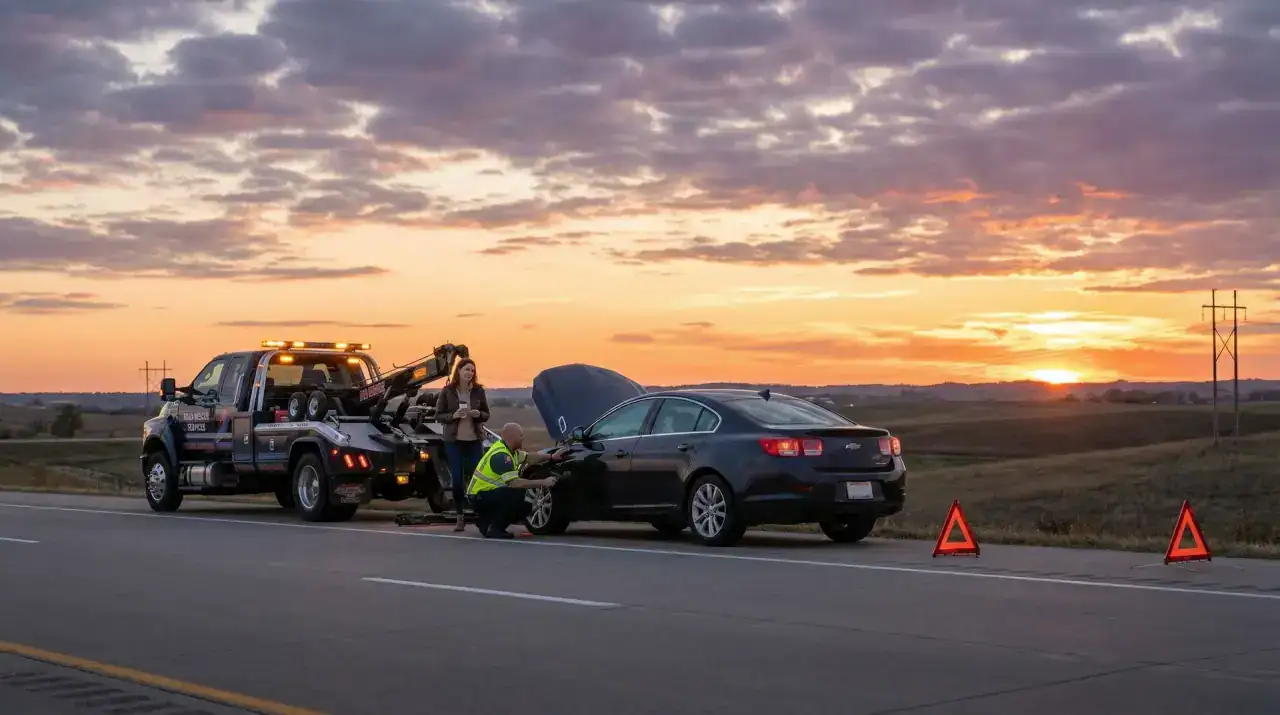
The first slick morning of a Columbus winter catches plenty of drivers with nothing in the car but an old receipt and a dead phone. A winter car kit does not need to be expensive or take up the whole trunk. It needs to keep you visible, warm and able to call for help until the problem is fixed, whether that is a dead battery in a Polaris parking lot or a slide-off on a county road east of Pickerington.
This guide covers what to keep in the car, why each item earns its space, and what to do if you end up stuck. If you would rather have help than handle it yourself, our roadside assistance covers jump starts, lockouts, fuel and spare-tire changes across Central Ohio, with no membership needed.
The short list: what the Ohio State Highway Patrol recommends
Short answer: the Ohio State Highway Patrol, in winter guidance shared by the Governor's office, tells drivers to stock a winter travel kit with an ice scraper, a shovel, jumper cables, a flashlight, blankets, a phone charger, a first aid kit, water and food.
That is the core. Everything below builds on it for the kind of winter Central Ohio actually gets: lots of freeze-and-thaw, wet snow, ice on bridges and ramps, and the occasional cold snap that kills batteries all over town on the same morning.
1. Stay visible and reachable
- A phone charger that works from the car, plus a small power bank kept charged. Your phone is how you call for help and how a truck finds you.
- A flashlight with fresh batteries, or a headlamp so your hands stay free. Winter dark comes early, and most breakdowns do not happen in good light.
- Reflective warning triangles or flares. On a shoulder of I-270 or I-71 at dusk, they give traffic behind you more warning than hazard lights alone.
- A bright cloth. The National Weather Service suggests tying a bright cloth, ideally red, to the antenna or door if you are stranded, so you are easier to spot.
- Our dispatch number saved in your phone: (740) 812-9489. Typing a number into a search bar with cold fingers is slower than you think.
2. Stay warm while you wait
- Blankets or a sleeping bag. A fleece blanket rolls up small enough to live under a seat.
- A hat, gloves and a spare pair of socks. Plenty of people drive in a light jacket because the car is warm; the jacket is not enough once the engine is off.
- Hand warmers. Cheap, light and easy to keep in the glove box.
- Water and snacks that keep, such as granola bars or nuts. They matter most on longer trips, like a drive down US-33 toward Lancaster or out I-70 past West Jefferson.
If you travel with children or a pet, pack for them too: an extra layer, something to drink and something to eat.
3. Clear the car and get moving
- An ice scraper and a snow brush. Clear every window, the headlights and the taillights, not just a peephole in the windshield.
- A compact shovel. A folding one fits in most trunks and is the first tool you reach for when a plow berm traps the car at the curb.
- Sand or kitty litter. A small bag poured in front of the drive wheels can give enough grip to get out of a slick spot.
- Jumper cables or a charged jump pack, but only if you know how to use them safely. A battery that is cracked, swollen or leaking should never be jumped.
- Washer fluid rated for winter. Salt spray on SR-315 or I-670 coats a windshield fast, and an empty reservoir leaves you driving half blind.
If the battery is already getting weak, a kit only buys you time. Our winter battery checklist covers the warning signs and when to get it tested before the cold sets in.
4. First aid and the small things
- A basic first aid kit, plus any medication you cannot go a few hours without.
- A pen and a notepad, for an accident report or a plate number when your phone is low.
- A small amount of cash, in case a card reader is down.
- Your owner's manual, which shows where the jack points, the spare tire and the tow hook are on your car.
Where to keep the kit
Put the things you need first, like the phone charger, flashlight, gloves and scraper, inside the cabin where you can reach them without getting out. Keep the shovel, sand and blankets in the trunk or cargo area, packed in a bin or bag so they do not slide around. If you drive a pickup with an open bed, keep the kit in the cab, where it stays dry.
Check the kit when you change the clocks in the fall and again in mid-winter: swap the water and snacks, recharge the power bank and test the flashlight.
If you get stuck or break down
Get safe first
The Highway Patrol's advice for a breakdown is simple: turn on your hazard lights, move the car as far off the roadway as you can, stay in the vehicle and call for help. Call 911 if anyone is hurt, if the car is stopped in a live travel lane, or if you are in danger in a winter storm. The Patrol's non-emergency line is #677.
Stay with the car and keep the exhaust clear
The National Weather Service advises staying with your vehicle rather than walking off for help. If the engine runs for heat, the tailpipe must be clear of snow, because a blocked exhaust can push carbon monoxide into the cabin. The Weather Service suggests running the engine about 10 minutes each hour, cracking a window on the side away from the wind, and checking the exhaust pipe from time to time.
Know when to stop digging
A little shoveling and some sand can free a car that is barely stuck. If the wheels only spin, the car is in a ditch, or it is sitting at an angle, stop. Spinning tires dig the car in deeper, and pushing a car out of a ditch next to traffic is how people get hurt. That is what a winch-out is for: the operator pulls the car back onto solid ground with a cable from the truck, then checks whether it can be driven or needs a tow.
What we can handle when the kit is not enough
Dispatch runs around the clock, and our roadside assistance covers Columbus and the surrounding communities, from Dublin and Westerville to Grove City. Most metro calls are reached in 20–40 minutes and outer communities in 40–60; that is an estimate, and snow days can stretch it.
- Dead battery: a jump start with a battery and charging-system test included.
- Flat tire: we fit your spare through our tire change service. We do not repair tires on the roadside; if there is no usable spare, we tow the car to a tire shop.
- Locked out: we unlock the car. We do not cut, make or replace keys.
- Out of fuel: fuel delivery brings enough to reach the nearest station.
- Stuck or slid off: a winch-out, or a tow if the car cannot be driven.
Jump starts, lockouts and tire changes are a flat $75 plus en-route at $4 per mile from our yard, and veterans get 10% off with a military or VA ID. The full rate card lists the after-hours, weekend and highway surcharges, and dispatch gives you the price before the truck rolls. For more on what fails when the weather turns, see our guide to fall breakdown risks in Columbus.
Frequently asked questions
What should be in a winter car emergency kit?
Start with what the Ohio State Highway Patrol recommends: an ice scraper, a shovel, jumper cables, a flashlight, blankets, a phone charger, a first aid kit, water and food. Add warm clothing, gloves and a hat, something for traction such as sand or kitty litter, and warning triangles or flares.
Should I stay in my car if I get stuck in the snow?
Yes. The National Weather Service advises staying with your vehicle rather than walking off for help. Keep the exhaust pipe clear of snow, run the engine only about 10 minutes each hour for heat, and crack a window on the side away from the wind.
Who do I call if my car breaks down on an Ohio highway?
Call 911 if anyone is hurt, the car is in a live travel lane or you are in danger. The Ohio State Highway Patrol's non-emergency line is #677. Once you are safe, call a tow or roadside company for the car itself.
When should I put a winter kit in my car?
Before the first snow, so the kit is in place on the first slick morning rather than the second. Check it again partway through the season: replace water and snacks, recharge the power bank and put fresh batteries in the flashlight.
Stuck, stranded or just out of luck this winter? Call (740) 812-9489 or send your location from the SOS request page.