A new driver's first winter is a different test from the one they passed. Driver's ed and the road test usually happen on dry pavement in good light, and then November arrives: dark by dinnertime, frost on the windshield, and the first slushy commute on I-270. For parents in Columbus, the goal is not to keep a teen off the road all winter. It is to make sure they know what to do before something goes wrong, and who to call when it does, whether that is you, 911 or roadside assistance.
Here is a practical plan for a teen's first Central Ohio winter: what to practice, what to keep in the car, and a simple script for the moment the car slides, dies or gets stuck.
Practice in a safe place before the first real snow
Reading about skids does not prepare anyone for the feeling of a car that will not stop where it should. The best lesson is a supervised one. After the first snowfall, find a large, empty, legal place to practice, such as a church or school lot on a weekend when it is closed and you have permission, with no light poles or curbs nearby. Then work through a few drills together:
- Gentle starts. Ease onto the gas from a stop so the wheels do not spin. Feel how little throttle it takes on snow.
- Long, early braking. Brake from a low speed and notice how much farther the car travels. If the car has anti-lock brakes, press firmly and steadily and let the pedal pulse; do not pump it.
- Look where you want to go. If the rear of the car steps out, the natural reaction is to stare at what you are afraid of hitting. Practice looking and steering toward the open space instead, with smooth hands and no sudden jerks.
- Turning at walking speed. Take a few slow turns to feel the front tires push wide when the car goes in too fast.
Keep the speed low the whole time. The point is to learn how the car feels, not to slide it around on purpose.
The habits that matter most on Columbus roads
Most winter trouble for new drivers comes from a few habits, not from bad luck. Talk through these before the first cold snap:
- Slow down before the road tells you to. Posted limits are for dry pavement. On snow or slush, speed is the single biggest thing a driver controls.
- Leave much more room. Following closely is the habit that turns a slick morning on I-71 or SR-315 into a rear-end crash. Double the gap you would leave in summer, and more when it is actively snowing.
- Treat bridges, ramps and overpasses as icy. They freeze before the road around them. The loops where I-270 meets US-23 or US-33 are a good place to ease off well before the curve.
- No cruise control on wet, snowy or icy roads. The driver should be in full control of the throttle.
- Phone down, always. Winter driving leaves no spare attention for a text. Set the navigation and music before pulling out.
- Headlights on whenever it is snowing, raining or getting dark, so other drivers can see them.
- Give plows room. Stay well back from a plow or salt truck and never pass one on the right.
If your teen has never had to merge onto a freeway in slush, consider keeping their first few snow days to familiar local streets, then riding along for that first trip on I-270.
Get the car ready, and teach them to check it
Many teens drive a hand-me-down car, which is often the one with the oldest battery and the most worn tires in the family. A short check before winter, done together so they learn it, goes a long way:
- Battery. Have it tested if it is getting old or the car has started cranking slowly. Our guide to testing a car battery before winter walks through it.
- Tires. Check the tread and the pressure. Cold weather drops tire pressure, so a warning light on the first cold morning is common. Show them where the spare and jack are, too.
- Wipers and washer fluid. Fresh blades and a winter washer fluid that will not freeze in the lines.
- Lights. Walk around the car with the headlights, brake lights and turn signals on.
- Fuel. Make a house rule to keep the tank from running low in winter. A car that stalls on an empty tank in the cold leaves the driver without heat.
Finally, teach them to clear the whole car before they drive, not just a hole in the windshield: every window, the mirrors, the lights and the snow on the roof.
What to keep in a new driver's car
A teen does not need a trunk full of gear, just the basics in a bag that stays in the car all season. Our full winter car emergency kit list goes deeper, but for a new driver start with:
- A phone charging cable and a small charged power bank
- An ice scraper and snow brush
- Gloves, a hat and a warm blanket, since a hoodie is not winter clothing
- A flashlight and a few road flares or reflective triangles
- Water and a couple of snacks
- A written card with your number, the insurance information and our number, (740) 812-9489, in case the phone dies
The script: what to do if something goes wrong
Panic makes everything harder. A simple, rehearsed plan helps a new driver stay calm. Go over these steps at the kitchen table, and have them repeat it back:
- Get safe first. If the car can still move, get it as far off the road as possible and turn on the hazard lights.
- Dial 911 first when someone is injured, when the car is sitting in a lane with traffic moving past, or when a winter storm makes them feel unsafe. The car can be dealt with later.
- Stay buckled in the car on a busy road like I-270 or I-70. Standing next to a car on a freeway shoulder is one of the most dangerous places to be.
- Call a parent and share the location from the phone's map.
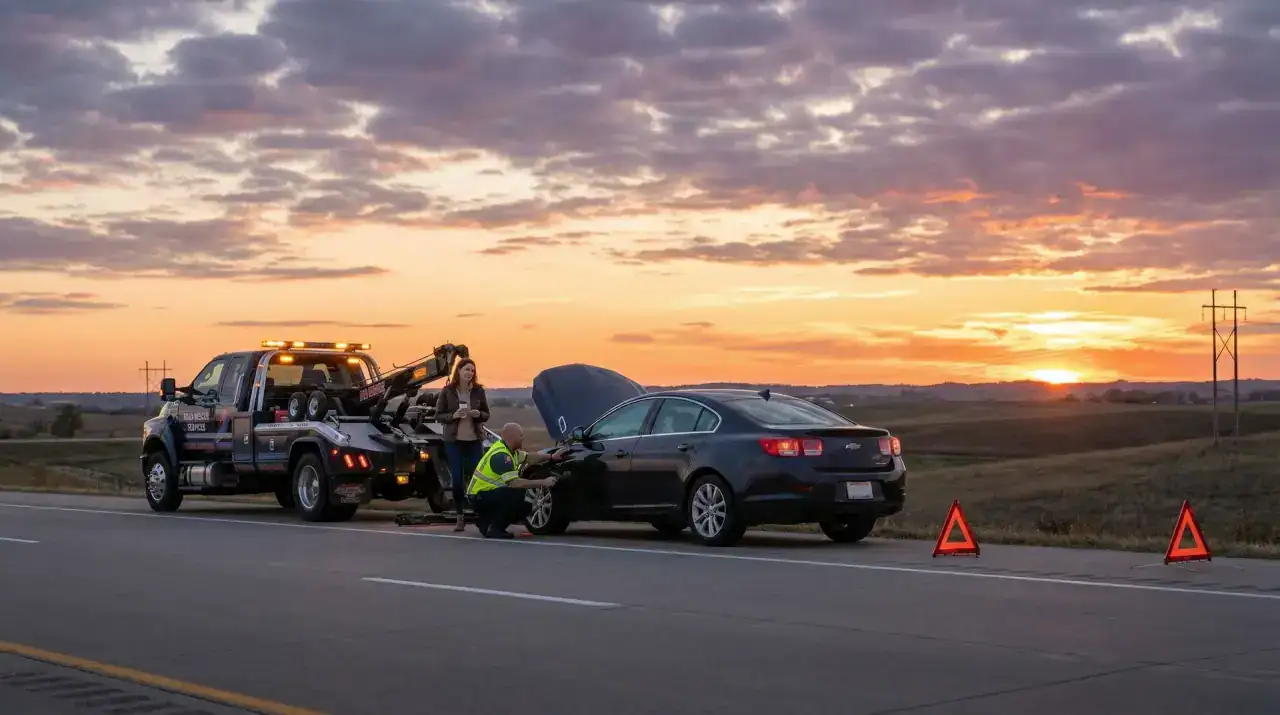
- Call for help with the car. A dead battery needs a jump start, a flat needs a spare tire change, and a car that slid into a snowbank or ditch needs a winch-out or a tow.
- Do not spin the tires for minutes on end trying to get out. That digs the car in deeper and can damage it.
- Waiting in the cold with the engine on? Make sure snow is not blocking the tailpipe, and open a window a little on the side out of the wind.
If the car slides off the road, our post on what to do when a car slides into a ditch covers the next steps in more detail.
One more common call: a teen warms up the car, closes the door, and the keys are still inside. Our lockout service can get them back in. We unlock cars only; a lost or broken key needs a dealer or locksmith.
Set the family rules now
Rules work best when they are agreed before the first bad night, not argued about in the moment. A few worth settling now:
- Check the forecast before leaving, and it is always fine to stay put or ask for a ride when the roads look bad.
- Text when they leave and when they arrive on snowy nights.
- A call for help never gets them in trouble. You would much rather hear about a dead battery or a slide-off right away than have them try to fix it alone in the dark.
- Save our number in their phone as a contact, so they are not searching for a tow company with cold hands on the side of the road.
When your teen needs help, we are a call away
Our roadside assistance covers jump starts, spare tire changes, fuel delivery and lockouts around the clock, and we tow the car to a shop or home when it cannot be fixed on the spot. A parent can call on their teen's behalf; just give dispatch the location and the car.
How fast a truck arrives is always an estimate, and winter roads add time. Most metro calls are reached in 20–40 minutes, which covers places like Dublin; outer communities such as Westerville are usually 40–60. West and southwest-side calls, Grove City among them, typically run 15–30 minutes.
For roadside help like a jump or a spare tire change, the price is $75 flat plus $4 for each mile the truck drives to reach you. If the car has to be towed, that is $125 to hook up and $7 for every mile it is carried. Show a military or VA ID and veterans get 10% off. Night and weekend surcharges and the complete rate list sit on our pricing page, and our dispatcher tells you the price on the phone before anyone is sent.
Frequently asked questions
How can my teen practice driving in snow safely?
After the first snowfall, ride along in a large, empty lot where you have permission to be, away from poles and curbs. Practice gentle starts, long early braking and slow turns at low speed so they learn how the car feels on snow. Then ride along for their first trips on busier roads.
What should a new driver keep in their car in winter?
A phone cable and charged power bank, an ice scraper and brush, gloves, a hat and a blanket, a flashlight, water and snacks. Add a written card with a parent's number, the insurance information and a towing number in case the phone dies.
What should my teen do if their car breaks down or slides off the road?
Get as far off the road as possible and turn on the hazard lights. Call 911 if anyone is hurt, the car is in a live travel lane or they feel unsafe, otherwise stay buckled in the car, call a parent and share the location. Then call for a jump, tire change, winch-out or tow, and do not keep spinning the tires.
Can a parent call for a tow or roadside help for their teen?
Yes. A parent can call on their teen's behalf and give dispatch the car's location and a description of the car. Dispatch quotes the price before a truck rolls, and the driver will meet your teen at the car.
Teen stuck, stalled or locked out somewhere around Columbus? Call (740) 812-9489 any hour, or send the location from the SOS request page.