One second the car is moving, the next the back end steps out, and you are sitting at an angle in the grass with the hazard lights clicking. It happens on the first slick morning of every Columbus winter: on the ramps of I-270, in the median of I-71, and on the dark county roads out past Pickerington and Delaware where the ditches run right up to the pavement.
If you are reading this from the driver's seat, take a breath. Most slide-offs end with nobody hurt and a car that only needs to be pulled back onto solid ground. That is a winch-out, and it often means no tow at all. Here is what to do in the first few minutes, and what happens when the truck arrives.
First: is anyone hurt, and is the car in traffic?
Short answer: call 911 first if anyone is hurt, if any part of the car is in a live travel lane, or if you are in danger, such as stranded in a winter storm. Everything else can wait until you and your passengers are safe.
If nobody is hurt and the car is fully off the road, the Ohio State Highway Patrol's non-emergency line is #677. The Patrol's advice for a winter breakdown or slide-off is the same in its bulletins year after year: turn on your hazard lights, get the vehicle as far off the roadway as you can, stay in the vehicle and call for help.
Stay in the car (in most cases)
It feels natural to climb out and look at the damage, but on a freeway shoulder that is the most dangerous thing you can do. If your car slid there, the next driver to lose control is likely to slide to the same spot.
Both NHTSA and the National Weather Service tell drivers to stay with the car in winter weather rather than walking off for help. Get out only if staying is more dangerous, for example if the car is on fire, filling with smoke, or sitting where it is likely to be hit. If you do get out, move well away from traffic and up the bank, never between the car and the road.
Keep the exhaust pipe clear
If the car is nose-down in snow, the tailpipe may be buried. Running the engine with a blocked exhaust can push carbon monoxide into the cabin. NHTSA says to make sure the exhaust pipe is clear of snow and to run the car only long enough to stay warm. The National Weather Service suggests about 10 minutes each hour, with a window cracked open a little. If you cannot safely check the tailpipe, leave the engine off and bundle up.
Make the car easy to see
Keep the hazard lights on. NHTSA suggests putting a bright marker on the antenna or a window and keeping the dome light on, and the Weather Service suggests a bright cloth, ideally red, tied to the antenna or a door.
Don't spin the tires or try to push it out
A few gentle tries to drive out are fine if the car is barely off the pavement, on level ground, away from traffic. Past that, stop:
- Spinning tires dig in. Wheelspin polishes snow and deepens ruts until the car ends up resting on its frame.
- It is hard on the car. Long wheelspin heats up the transmission, and rocking hard between drive and reverse can damage it.
- Pushing puts people in the worst place. Friends pushing on a shoulder are standing exactly where the next sliding car would go, and a car on a slope can roll back onto whoever is behind it.
If the car is tilted on an embankment, sitting on its frame, or partly on its side, do not try anything. Turn the engine off if you cannot check the tailpipe, stay buckled in, and call.
What to tell dispatch when you call
Have this ready so the right truck shows up:
- Where you are. The road, the direction you were heading, and the nearest exit, mile marker or cross street. "I-270 westbound past the US-33 exit" is much better than "on 270." You can also send your GPS location from our SOS request page.
- How the car is sitting. Just off the pavement, nose-down in the ditch, on a slope, or tipped onto its side.
- What it is stuck in. Snow, mud, a soft median, or hung up on a curb or guardrail end.
- The car itself. Make and model, and whether it is all-wheel drive, electric or lowered, since that changes which truck and rigging we send.
- Whether anyone is hurt and whether police are already on the way.
What a winch-out is (and when you need a tow instead)
A winch-out recovery is for a car that is stuck, not broken. The operator parks the truck on solid ground, sets it so it will not move, and runs a cable down to the car. The cable hooks to the car's frame or its factory recovery point, never to a bumper cover or a suspension arm. Then the car is pulled back to the pavement slowly while the operator watches underneath.
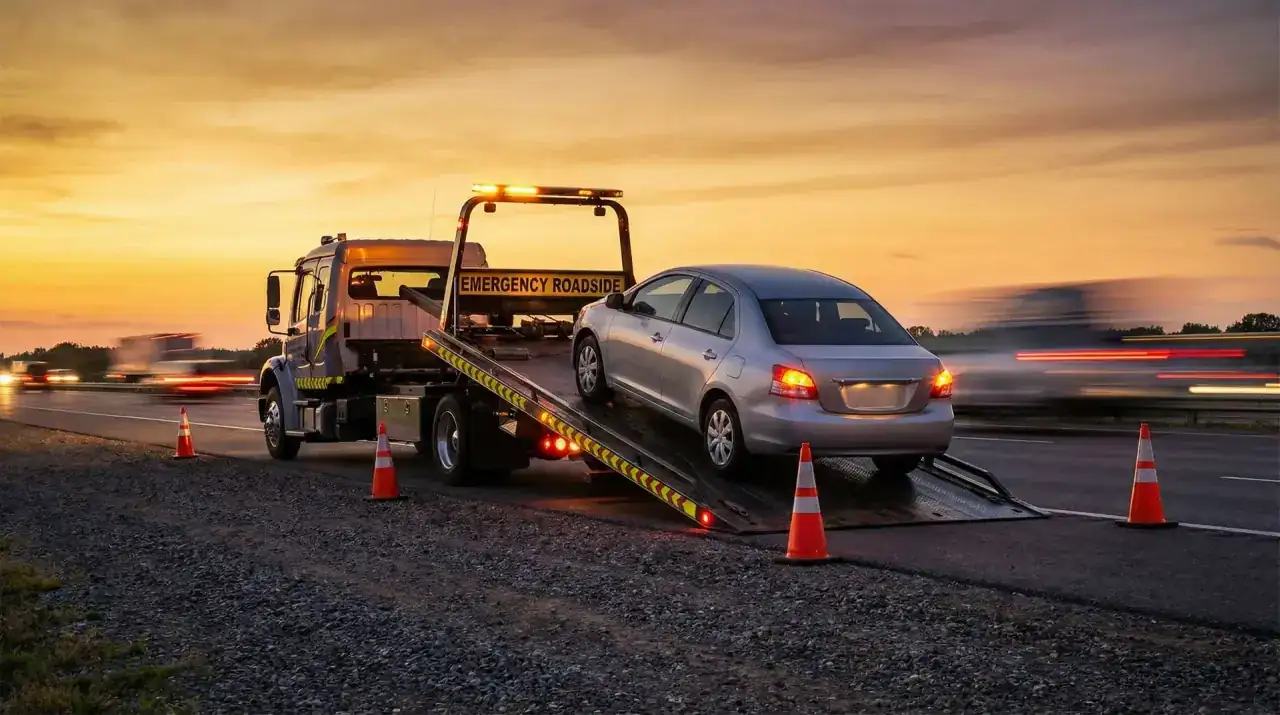
Once it is back on the road, we look it over with you. If it is fine, you drive away; if not, the same truck tows it to the shop of your choice, with no second call. When a car is badly damaged or will not roll, a flatbed tow carries it with all four wheels off the ground.
If the car hit something on the way into the ditch, like a sign, a fence or another car, it is a crash, not just a slide-off. Our guide on what to do after a car accident in Columbus covers the police report, photos and insurance steps.
Check the car before you drive it home
A slide-off can do damage you do not see at first. Look for a bent wheel or soft tire, fluid dripping underneath, a splash shield dragging, new warning lights, or a steering wheel that is off-center. If any of these show up, have the car towed rather than driven. If it is just a flat and you have a usable spare, our tire change service fits it. We do not repair tires on the roadside; with no usable spare, we tow the car to a tire shop.
Where Central Ohio drivers slide off
The Highway Patrol reminds drivers every winter that bridges, ramps and overpasses freeze first. Around Columbus that means the curving ramps of the I-270 outerbelt, the interchanges where I-70 and I-71 split downtown, and the bridges along SR-315 and US-33. Out in the country, two-lane roads with deep drainage ditches on both sides leave no room for error in places like rural Delaware County, the roads around Canal Winchester and the farm roads west of Hilliard.
The Patrol's advice for staying on the road is simple: slow down, because accelerating, turning and braking all take longer on snow, and leave more room to the car ahead. If the car starts to skid, ease off the gas and steer in the direction you want to go. Our winter car emergency kit guide covers what to keep in the car so a slide-off is uncomfortable rather than dangerous.
Give the tow truck room: Ohio's Move Over law
Under Ohio Revised Code 4511.213, when you approach a stopped road service vehicle such as a wrecker with its lights flashing, you must move over a lane if you safely can. If you cannot change lanes safely, slow down and go by with caution.
What a winch-out costs
Winch-outs are billed by the hour from our published rate card, plus en-route at $4 per mile from our yard, and most straightforward recoveries are done inside the first hour. If the car then needs a tow, that is a $125 hook-up plus $7 per loaded mile. After-hours, weekend and highway surcharges are listed on the rate card, veterans get 10% off with a military or VA ID, and dispatch gives you the price before the truck rolls.
Dispatch runs 24 hours a day. Most metro calls are reached in 20–40 minutes and outer communities in 40–60; that is an estimate, and the first big snow of the season can stretch it. Besides winch-outs, our emergency towing and roadside assistance cover the other things that go wrong on a cold night, from dead batteries to lockouts.
Frequently asked questions
Should I call 911 if my car slides into a ditch?
Call 911 if anyone is hurt, the car is blocking or partly in a live travel lane, or you are in danger, such as stranded in a winter storm. If nobody is hurt and the car is fully off the road, the Ohio State Highway Patrol's non-emergency line is #677, and a tow or recovery company handles the car itself.
Should I stay in my car after sliding off the road?
Usually, yes. The Ohio State Highway Patrol advises turning on your hazard lights and staying in the vehicle, and NHTSA and the National Weather Service both say to stay with the car in winter weather. Get out only if the car is unsafe, for example if it is on fire or likely to be hit, and then move well away from traffic.
What is a winch-out?
A winch-out is a recovery where the operator anchors the tow truck on solid ground, hooks a cable to the car's frame or recovery point, and pulls the car back onto pavement at a controlled speed. If the car is undamaged it can be driven away; if not, the same truck can tow it.
Can I drive my car after it slid into a ditch?
Sometimes, but check first. Look for a bent wheel, a tire off the bead, fluid leaking underneath, a hanging splash shield or a steering wheel that is no longer straight. If any of those show up, or the car pulls hard or shakes, have it towed to a shop rather than driven.
Is it safe to push a car out of a ditch?
Not next to traffic. People pushing a car on a shoulder stand in exactly the place a sliding car would go, and a car on a slope can roll back on whoever is pushing. A few gentle tries on level ground away from traffic are reasonable; past that, call for a winch-out.
Slid off the road and stuck? Stay buckled in, keep the hazards on and call (740) 812-9489, or send your location from the SOS request page. If anyone is hurt or the car is in a travel lane, call 911 first.