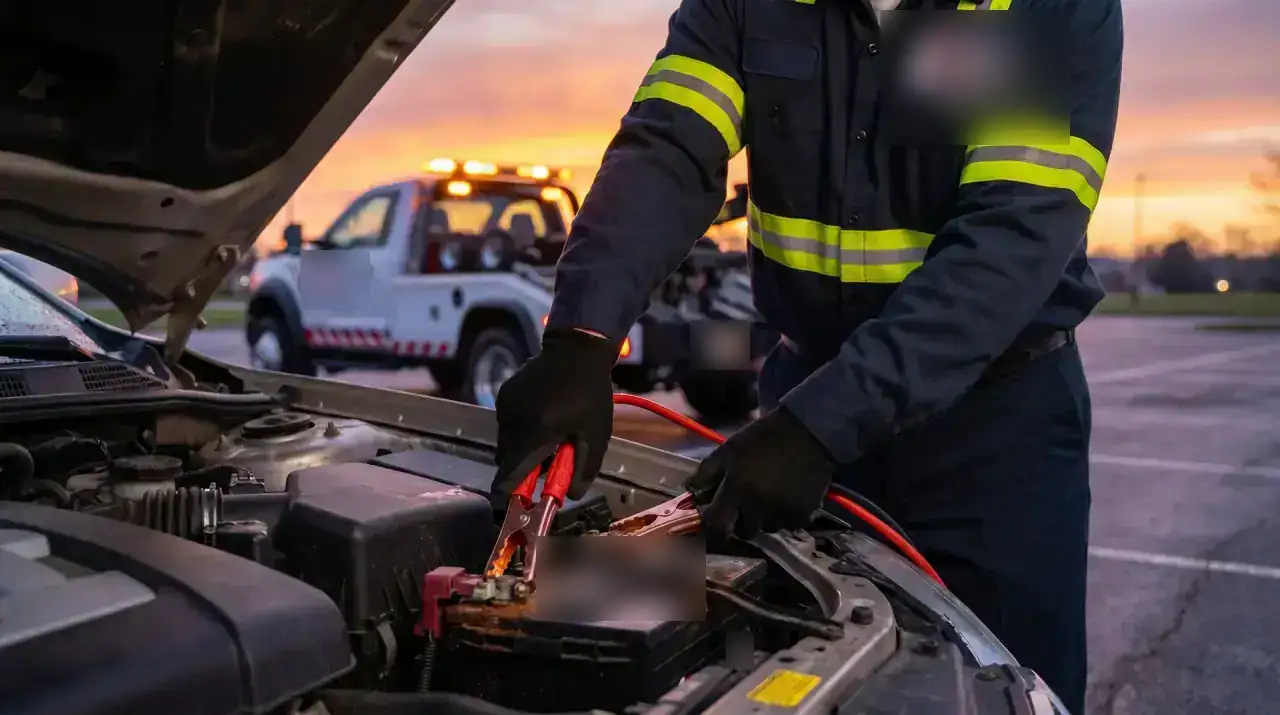
You worked a long shift, came back down the stairwell, and the car that started fine this morning now just clicks. A dead battery is annoying anywhere, but inside a garage near the Arena District, on the Ohio State campus or at Polaris it comes with extra problems: no room to pull another car nose to nose, one bar of signal, a low ceiling, and a gate between you and the street.
This guide covers why batteries so often quit in garages once the weather turns cold, what to check before you call anyone, how to get a jump safely in a tight space, and what to tell dispatch so the right truck shows up the first time. When the car will not start on a garage level, our parking garage recovery crew uses low-clearance equipment and portable jump packs built for exactly this situation.
Why batteries die in parking garages in winter
Short answer: the garage usually is not the cause. It is just where a weak battery finally runs out of margin.
Cold slows the chemistry inside a battery, so it delivers less starting power right when a cold, stiff engine needs more. A battery that has been getting weaker for months can still manage on a mild morning and then fail at the end of a cold day. A few garage habits make that more likely:
- The car sits all day. Commuters park in the morning and do not come back for eight or more hours, often on the open upper decks where wind keeps the car cold.
- Short trips. A quick commute does not give the alternator much time to recharge.
- Something left on. Headlights, a dome light, a trunk that did not latch or a phone charger in an always-on outlet can drain a tired battery while you are at work.
- An aging battery. Summer heat wears batteries down, and that damage tends to show up on the first cold stretch. If yours is several years old and has never been tested, our guide to testing a car battery before winter explains what the numbers mean.
First: make sure you are safe
Garages are usually calmer than a highway shoulder, but they have their own risks. If anyone is hurt, a child or pet is locked inside the car, or you feel unsafe, call 911 first. Many garages also have a security office or an emergency call box; using it is a good idea if it is late and the deck is empty.
Otherwise, turn off the headlights, fan and radio so whatever charge is left is not wasted, and let the attendant or security office know the car is disabled. They can often open the gate for a service truck, and they will not ticket a car they know is broken down.
Quick checks before you call
A minute of looking and listening tells you, and us, a lot:
- Rapid clicking or a slow, tired crank almost always points to a weak or drained battery. A jump is likely to work.
- Normal cranking speed but the engine never catches is usually not the battery. A jump will not help, and the car may need a tow to a shop.
- A push-button car that will not respond at all can be a dead key fob battery rather than the car battery. Many cars let you start them by holding the fob against the start button or placing it in a marked spot; the owner's manual shows where.
If the sounds do not match any of these, our article on telling a battery from a starter or alternator problem covers the rest.
Why a regular jump is harder inside a garage
The classic jump, with a friend parking nose to nose, often does not work on a garage level. Spaces are narrow, cars are packed side by side, and the battery may be on the side of the engine bay facing a concrete wall. Standard jumper cables rarely reach from a car in the drive aisle.
There is also the air to think about. Running engines in an enclosed or underground level adds exhaust to a space with limited fresh air. Keep any idling short, never sit in a running car on a closed lower level for a long stretch, and get out and into fresh air if you feel dizzy or get a headache.
A portable jump pack solves most of these problems. It needs no second car, fits in a tight space and only has to reach the battery or the jump points under the hood. If you have one, follow its instructions and the clamp order in our winter jump-start guide. Do not try to jump a battery that is cracked, swollen, leaking or looks frozen.
What to tell dispatch from a garage
A garage can have several entrances, many levels and dozens of rows that all look the same. These details save the most time:
- The garage name and street address, plus which entrance you used if there is more than one.
- The level, the row or color zone, and the nearest elevator or stairwell. Snap a photo of the level marker on the nearest pillar before you walk off to find signal.
- The posted clearance at the entrance, if you noticed it, so dispatch can confirm the right low-clearance unit before anyone rolls.
- Year, make and model, and whether it is a hybrid or EV, since those have their own jump points and rules.
- What happens when you try to start it: clicking, slow crank, normal crank, or nothing.
- Whether the garage has a gate or attendant, and whether a service truck needs a ticket or code to get in.
Concrete blocks cell signal, so you may need to walk to an open edge or the street to call. Photograph your location first so you can find the car again.
Jump, new battery, or tow?
Most garage calls end with the car started on the spot. When the driver arrives, they test the battery, start the car with a jump pack if it is safe to do so, and check whether the charging system is doing its job.
- The battery is just drained (lights left on, a long cold day): a jump start and a real drive home, not a two-minute errand, is usually enough.
- The battery fails the test: our mobile battery replacement can install a new one right there on the garage level, so you do not have to get a jump, drive to a store and hope it starts again.
- The car still will not run: it needs to come out of the structure and go to a shop. Our garage recovery crew moves non-running cars through tight lanes with go-jacks, dollies and compact wheel-lift units, then hands off to a flatbed at street level when needed. EVs and hybrids are moved with all four wheels off the ground.
Locked your keys inside while you were sorting all this out? Our lockout service can open the car. We unlock cars only; we do not cut or replace keys.
How to avoid a garage dead battery this winter
- Get the battery tested before the coldest weeks, especially if it is a few years old. Our Columbus winter battery checklist lists the warning signs.
- Check as you walk away: headlights and dome light off, doors and trunk shut, chargers unplugged.
- Take a longer drive once a week if most of your trips are short commuter hops.
- Keep a charged jump pack in the car and recharge it every few months, since packs lose charge in the cold too.
What it costs and how fast we get there
Our phones are staffed day and night. Downtown and most of the metro, including Bexley and Worthington, is usually reached in about 20–40 minutes; outer communities take about 40–60. Those are estimates, not promises, and snowy days slow every road.
A jump start in a garage is $75 flat plus $4 per mile en-route from our yard. If the battery needs replacing, it is priced by size and quoted from the test reading before any work begins. If the car has to come out on a truck, the tow is a $125 hook-up fee plus $7 per loaded mile, and veterans with a military or VA ID save 10%. Night, weekend and any garage recovery surcharges are on our pricing page, and dispatch gives you the full price before a truck heads your way.
Frequently asked questions
Why does my car battery die in the parking garage at work?
Usually the garage is just where a weak battery finally gives out. The car sits cold all day, short commutes do not fully recharge it, and a light or accessory left on drains what is left. Cold weather reduces the power a battery can deliver, so an aging battery that started the car in the morning may not manage it again by evening.
Can a tow truck get into a parking garage?
A full-size tow truck usually cannot, because most garages have low ceilings. Garage recovery uses low-clearance equipment, portable jump packs, go-jacks and dollies instead. Tell dispatch the posted clearance at the entrance if you saw it, so the right equipment is sent.
Is it safe to jump-start a car inside a parking garage?
Usually, if the battery is not cracked, leaking, swollen or frozen and you keep engine idling short on enclosed or underground levels. A portable jump pack is often the easiest option because it does not need a second car parked nose to nose. If you feel dizzy or get a headache, move to fresh air right away.
What should I tell the tow company when my car is stuck in a garage?
Give the garage name and address, the entrance you used, the level, row and nearest elevator or stairwell, and the posted clearance if you noticed it. Add the year, make and model, whether it is a hybrid or EV, and what happens when you try to start it. Mention any gate, attendant or ticket needed to get in.
Can you replace my battery in the garage instead of towing the car?
Often, yes. The driver tests the battery first, and if it fails, mobile battery replacement installs a new one right on the garage level. If the car still will not run after that, it is moved out of the structure and towed to a shop, with the price quoted before any work starts.
Car dead on a garage level? Call (740) 812-9489 any hour, or send us your location from the SOS request page.