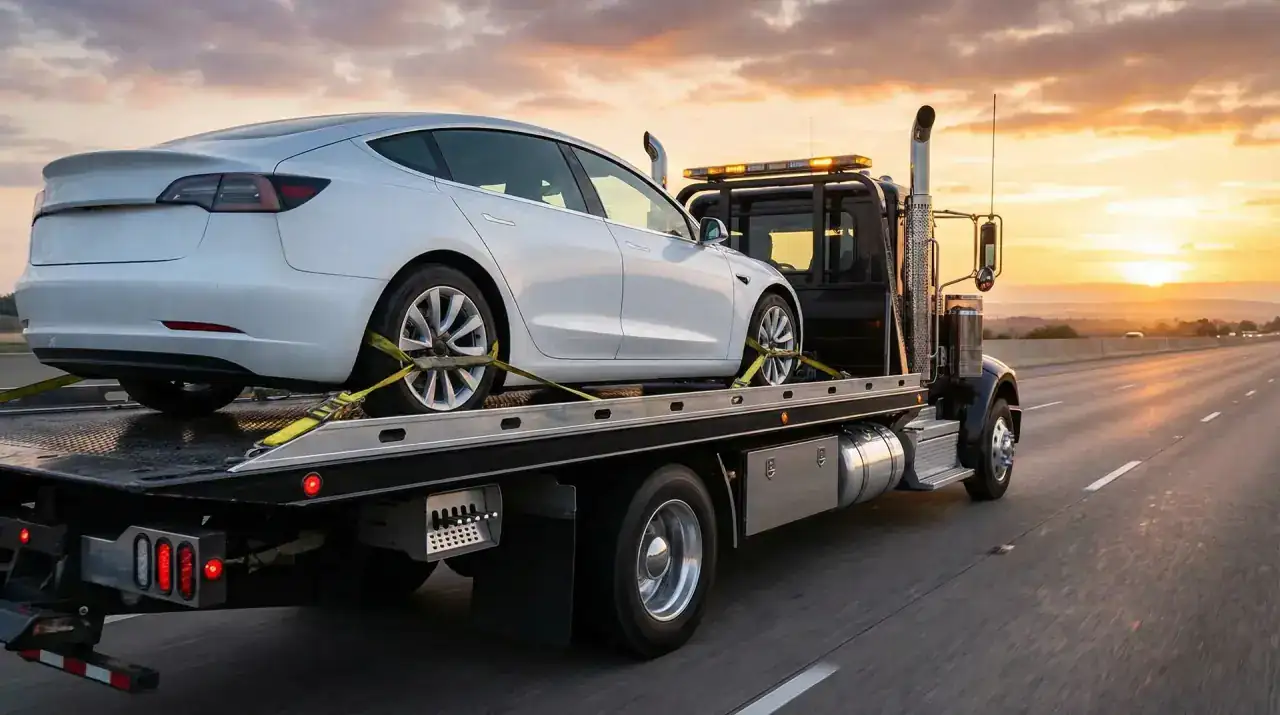
A lowered car is a joy on a dry back road and a headache the morning after a Columbus snowfall. The plow leaves a hard ridge across the end of the driveway, the side street has not been touched, and every rut is taller than the front lip. Push through it the way a crossover would and you can tear off a splitter, crack an undertray or end up perched on packed snow with the tires spinning in the air.
This guide is for owners of lowered builds, sports cars, and sedans and EVs with long, low noses. It covers getting the car ready, driving and parking it when snow is on the ground, what to do if it gets stuck, and how a low car should be loaded when it needs a tow. When it does, our low profile towing service loads it slowly, with ramp boards and wheel straps, at any hour.
Why low cars have a harder winter
Short answer: snow raises the ground. A car that clears dry pavement with a little room to spare has no room at all once there is slush, a plow ridge or frozen ruts under it.
Three things go wrong most often. The nose hits first: a front lip, air dam or splitter meets a snow bank or ridge before the tires do, and plastic loses that fight. The middle drags: packed snow between the wheel tracks rubs along the underbody, and in deeper snow the car can rest its weight on it, which is what people mean by high-centered. And the snow gets packed into places it should not be, such as wheel wells, around brake parts and inside the lower grille, where it can freeze solid overnight.
Get the car ready before the first real snow
- Tires first. Performance summer tires lose much of their grip in the cold and are a poor match for snow and ice. Many low-car owners run a dedicated set of winter tires on separate wheels, and that one change does more than anything else on this list.
- Know your lowest point. Walk around the car and look underneath. On many cars it is the front lip or air dam; on others it is an exhaust pipe, a subframe brace or side skirts. That is the part you are protecting all winter.
- Consider a seasonal setup. Owners with adjustable coilovers or air suspension often raise the car for winter, and some remove a bolt-on splitter or lip until spring.
- Find the tow eye now. Most modern cars carry a screw-in tow eye in the trunk or spare-tire area, with a small cover on the bumper where it threads in. Find both before you need them.
- Keep a small shovel in the car, along with the usual winter kit. Our winter car emergency kit guide covers the rest.
Driving a low car in Columbus snow
The main roads are usually the safest bet: the freeways and arterials tend to be plowed and treated first, while side streets, cul-de-sacs and apartment lots can stay rutted for days.
- Stay in the cleared tracks. The tire tracks from earlier traffic are usually the lowest, firmest path. The ridge of snow between and beside them is what scrapes.
- Take curbs, driveway lips and plow ridges at an angle, one front wheel at a time, the same way you take a steep driveway in summer. Hitting a ridge straight on puts the whole nose into it at once.
- Avoid unplowed lanes. If you can hear snow brushing the underbody, you are already deeper than the car was built for. Turn around while you still can.
- Go easy on the throttle. Powerful rear-drive cars break traction easily in the cold. Smooth inputs matter most on ramps and bridges, which can be icy when the rest of the road looks fine.
Parking: where low cars get trapped
More low cars get stuck pulling out of a parking spot than on the road. A few habits help:
- Back into your driveway or garage when snow is coming, so you drive out forward, with a better view of the ridge the plow leaves behind.
- Clear the plow ridge before you drive over it, not after you have hit it. A few minutes with a shovel at the end of the driveway is cheaper than a new front lip.
- Avoid spots facing a snow pile. Lots tend to push snow into banks at the edges and ends of rows. Pull nose-first into one and the bank can be right under your front bumper by morning.
If your low car gets stuck
Safety comes before the car. Call 911 first if anyone is injured, the car is sitting in a lane where traffic is moving, or a winter storm has you stranded. If the car is off the road and you are safe, then work on getting it out.
- Stop spinning the tires. Spinning digs the tires in, turns snow into ice and can overheat parts of the drivetrain.
- Check the exhaust. If you will be sitting in the car with the engine running, make sure the tailpipe is not buried in snow.
- Look underneath. If the car is resting on packed snow, more power will not help. Shovel the snow out from under the nose and sides so the weight goes back onto the tires.
- Try a slow, gentle start, in the lowest gear or with any snow mode the car offers, and straighten the front wheels so they are not plowing sideways.
- Know when to stop. If the only way out is to drag the nose over a ridge, or someone suggests pushing on the bumper or tying a strap to whatever part is handy, stop and call. Bumper covers and suspension arms are not pulling points.
Our winch-out recovery service pulls a stuck car free using a proper attachment point, slowly and at a controlled angle, so the car comes out without new damage. If you are not sure whether a slide-off needs a winch or a full tow, our guide on what to do when your car slides into a ditch walks through the decision.
How a low car should be towed
If the car is damaged, will not run, or simply should not be driven in the conditions, it needs to go on a truck, and how it gets loaded matters as much as the trip. Here is what proper low-clearance towing looks like:
- A shallow loading angle. A flatbed tilts its deck until the tail meets the ground. Where the truck parks changes that angle, so the driver picks level ground when there is a choice, and clears snow from the spot if needed.
- Ramp boards at the tail. Boards and pads under the front tires lift the car a little right where it meets the bed, so the nose passes over the edge instead of into it.
- A slow winch on the tow eye. The cable goes to the tow eye or a point the manufacturer names, and the car is pulled at walking speed while the driver watches the lowest point.
- Held by the tires. Soft straps wrap the wheels and hold the car to the deck, so nothing hooks onto the body or the suspension.
Low-clearance EVs follow one more rule: every wheel stays off the ground. That can mean a flatbed, or a wheel-lift with dollies, which is often the better fit in a tight, snowy spot. Our EV and Tesla towing page explains both methods, and our article on why electric cars need a flatbed or dollies covers the reasons.
What to tell dispatch
A minute of detail on the phone means the driver shows up ready for your car:
- Year, make, model and trim, and whether the car is lowered, on coilovers or on air suspension.
- Any lip, splitter, skirts or low exhaust, and what the lowest point is.
- Whether the car runs, rolls and steers, and whether it is an EV or hybrid.
- Where it is sitting: a snowy driveway, an apartment lot, a parking garage or the shoulder of I-270, and which way it is facing.
What it costs and how fast we get there
Someone picks up the phone day and night. For a car in Dublin or elsewhere in the metro, expect a truck in roughly 20–40 minutes; in outer towns like Westerville, roughly 40–60; and on the west side, Hilliard included, roughly 15–30. Treat those as estimates rather than promises, because a snow day slows every road in town.
There is no low-clearance surcharge; a low car costs the same as any other tow. You pay $4 per mile en-route from our yard, a $125 hook-up fee and $7 for each loaded mile, and veterans who show a military or VA ID save 10%. Surcharges for nights, weekends and highway calls are on our pricing page, and you hear the total from dispatch before anyone heads your way.
Frequently asked questions
Can a lowered car drive in snow?
On plowed, treated roads, usually yes, if it has proper winter tires and you drive gently. The trouble starts in unplowed streets, deep ruts and plow ridges, where the snow is taller than the car's lowest point. A low car can end up riding on packed snow with its tires barely touching the road, which is how it gets high-centered.
What should I do if my low car is high-centered on snow?
Stop spinning the tires, because that polishes the snow into ice and can overheat the drivetrain. Shovel the snow out from under the front and sides so the car's weight goes back onto the tires, then try a slow, gentle start. If it still will not move, or you would have to drag the nose over a ridge to get out, call for a winch-out instead of forcing it.
Should a lowered or sports car be towed on a flatbed?
A flatbed is the usual choice, loaded with the deck tilted as low as it goes, ramp boards at the tail and the car held by soft straps around the tires. That keeps the nose, skirts and underbody off the steel. Low-clearance EVs can also go on a wheel-lift with dollies, as long as all four wheels are off the ground.
Does it cost more to tow a lowered car in Columbus?
Not with us. A low car is billed from the same published rate card as any other tow, with no low-clearance surcharge. Dispatch quotes the full price before a truck rolls, and the rate card is on our pricing page.
Low car stuck in the snow, or need it moved without a scratch? Call (740) 812-9489 any hour, or send us your location from the SOS request page.