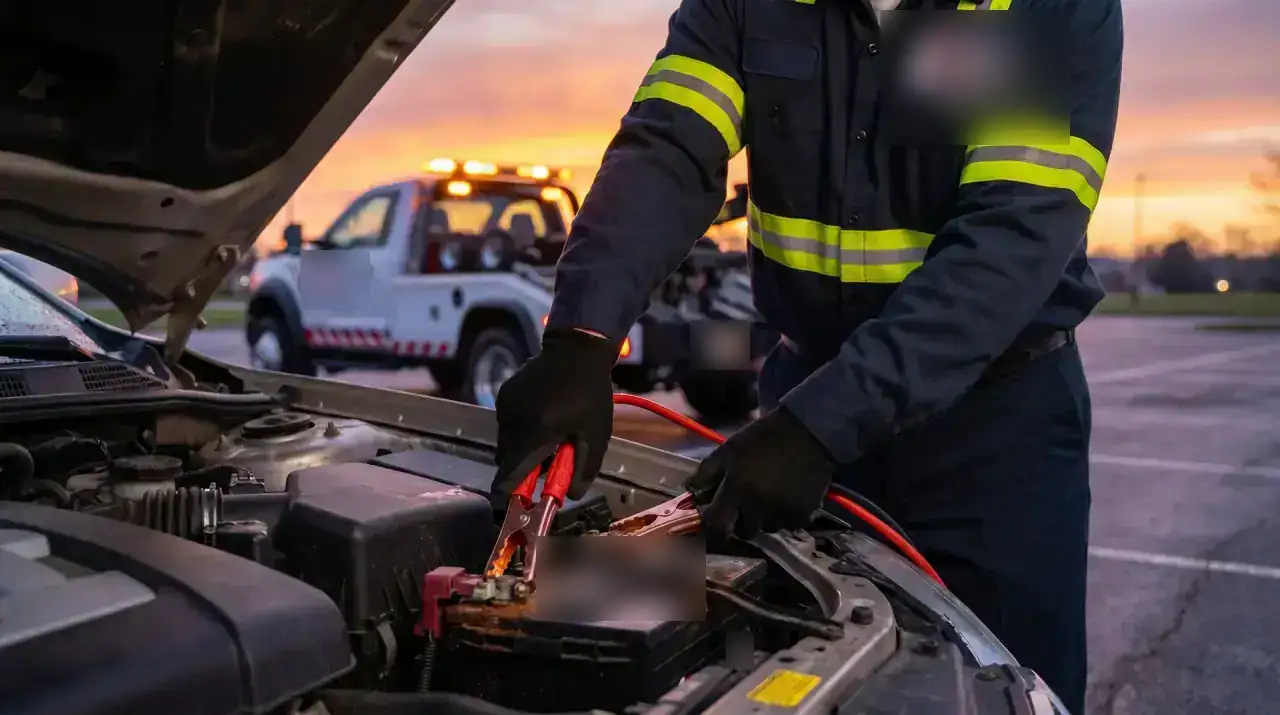
The car was fine last night. This morning the engine groans or does nothing at all, and a neighbor is walking over with cables. A jump start is one of the simplest roadside fixes there is, but on a dark, icy Columbus morning it is easy to get wrong: clamps on the wrong post, cables near a spinning fan, or a battery that should never have been jumped at all.
This guide walks through how to jump-start a car safely in winter, the cautions that matter on newer cars, and the signs that it is time to put the cables away and call. If you would rather not stand in the cold with the hood up, our jump start service comes to your driveway, office lot or garage level across Central Ohio, day or night.
Before you touch the cables: is this a jump-start problem?
Short answer: a jump helps when the battery is too weak to crank the engine. It does not help when something else has failed, and it can make a bad battery dangerous.
- Good signs for a jump: rapid clicking when you turn the key, a slow, labored crank, dim or flickering dash lights, or a car that was fine until it sat in the cold for a few days.
- Signs a jump will not fix it: the engine cranks at normal speed but never fires, which points to fuel or ignition instead; a single loud clunk with full-bright lights, which can be the starter; or a car that started fine but died while driving, which often points to the charging system.
Our guide to telling a battery from a starter or alternator goes deeper on those sounds.
When not to jump a battery at all
Open the hood and look at the battery before anything else. Leave it alone and call for help if you see any of these:
- A cracked, bulging or leaking case. Battery acid burns skin and eats paint, and a damaged case can fail violently when current is forced into it.
- Signs the battery is frozen. A deeply discharged battery can freeze on a bitter night. If the sides are swollen or you can see ice, do not jump it. Charging a frozen battery can make it rupture.
- A terminal that is loose, broken or melted.
- A smell of rotten eggs or visible venting near the battery.
Batteries give off hydrogen gas, which is flammable. Keep cigarettes, lighters and open flames well away, and do not lean directly over the battery while you work.
Where you are matters as much as how you do it
A driveway in Gahanna or a quiet apartment lot is a reasonable place to jump a car. The shoulder of I-270, I-71 or SR-315 is not. Getting two cars nose to nose on a highway shoulder puts you and the other driver between parked cars and live traffic, on pavement that may be slick, often in the dark.
If the car died on a highway or busy road, put the hazards on, stay belted in if it is safe to do so, and call for help instead of flagging down a stranger with cables. If the car is in a live travel lane, someone is hurt, or you are stranded in a winter storm, call 911 first.
Never run an engine for a jump inside a closed garage. Pull the good car out, or open the garage door fully and keep the exhaust pointed outside. Carbon monoxide builds up fast in an enclosed space.
Check the owner's manual first, especially on newer cars
Modern cars are full of electronics, and many manufacturers publish their own jump-start instructions. A few minutes with the manual can save an expensive mistake.
- Remote jump points. Many cars hide the battery in the trunk or under a seat and provide a positive terminal and a ground point under the hood instead. Use those, not whatever bare metal you can find.
- Hybrids and electric cars. These still have a small conventional battery that runs the computers and locks, and it can die in the cold. The manual will say whether the car can receive a jump and where to connect. Many manufacturers say not to use a hybrid or EV to jump another car.
How to jump-start a car safely, step by step
This is the standard sequence for a car with an ordinary battery and a helper car. Wear gloves you can actually grip with, and eye protection if you have it.
- Park the good car close, but not touching. Put both cars in park (or neutral with the parking brake on for a manual), turn both off, and take the keys out.
- Turn off everything electrical in both cars: headlights, heater fan, rear defroster, seat heaters, radio.
- Find the posts. Positive is usually marked with a plus sign and often has a red cover. Brush off snow, and wipe away light corrosion if you can do it safely.
- Red clamp to the dead battery's positive post.
- Other red clamp to the good battery's positive post.
- Black clamp to the good battery's negative post.
- Last black clamp to bare, unpainted metal on the dead car, such as an engine bracket or the ground point named in the manual, away from the battery. This is the connection most likely to spark, so you want it away from any battery gas.
- Route the cables clear of the fan, belts and anything that will move or get hot once the engine runs.
- Start the good car and let it run for a few minutes to put some charge into the weak battery. Cold batteries recover slowly, so be patient.
- Try the dead car. If it does not start, wait a few minutes and try again. Do not crank for long stretches; it overheats the starter.
- Once it runs, remove the clamps in reverse order: black from the jumped car, black from the good car, red from the good car, red from the jumped car. Do not let the clamps touch each other or the car body while any of them are still connected.
Using a portable jump pack
A charged jump pack is the easiest option in a tight garage or a lot where no one can park nose to nose. Follow the pack's own instructions. The winter catch: a pack left in a cold car loses charge too, so keep it topped up and bring it inside on the coldest nights.
After the jump: keep the engine running
A jump gets the engine started; it does not refill the battery. Drive the car for a real trip, with the fewest accessories you can stand, so the alternator has time to put charge back. Shutting it off in the driveway right away is the quickest way to need a second jump.
Then find out why it died. One jump after a cold snap is not a verdict, but a car that needs another jump the next morning has a battery that is finished, a drain, or a charging problem. Our post on how to test a car battery shows the checks you can do at home.
When to stop and call instead
Put the cables away and call when:
- the battery is cracked, swollen, leaking or might be frozen;
- the car still will not start after a few patient tries;
- you smell burning, see smoke, or a clamp or cable gets hot;
- you are on a highway shoulder or in a spot where traffic is too close;
- the manual for your hybrid, EV or luxury car calls for a procedure you are not comfortable with;
- the car starts but dies again soon after.
Our jump start calls include a battery and charging-system check once the car is running, so you leave knowing whether the battery or the alternator is the real problem. If the battery fails, our mobile battery replacement puts the right size in where the car sits, quoted before any work starts. If the car needs a shop, we can tow it there on the same call with emergency towing, and an EV always rides with all four wheels off the ground, on a wheel-lift with dollies or a flatbed.
Dispatch runs around the clock across Columbus and the suburbs. Most metro calls, including Dublin, are reached in 20–40 minutes, outer communities such as Gahanna in 40–60, and the west and southwest side, including Grove City, in 15–30. Those are estimates, and a snowy morning can stretch them.
A jump start is a flat $75 plus en-route at $4 per mile from our yard, and veterans get 10% off with a military or veterans ID. Our rate card lists the after-hours, weekend and highway surcharges, and you get the price before anyone is sent.
Frequently asked questions
What order do you connect jumper cables in?
Red to the dead battery's positive post, red to the good battery's positive post, black to the good battery's negative post, and the last black clamp to bare, unpainted metal on the dead car away from the battery. Remove them in the reverse order once the car is running, and never let the clamps touch each other.
Is it safe to jump-start a car in freezing weather?
Usually, yes, as long as the battery itself is not damaged or frozen. Look at it first: a cracked, swollen or leaking case, or visible ice, means do not jump it, because forcing current into a frozen battery can make it rupture. Work somewhere away from traffic, and never run the engines inside a closed garage.
Can I jump-start a hybrid or electric car?
Often, because hybrids and EVs still have a small conventional battery that can die in the cold. Check the owner's manual for where to connect, since many have dedicated jump points under the hood. Many manufacturers also say not to use a hybrid or EV to jump another car.
How long should I drive after a jump start?
Long enough for a real trip, not just around the block, with as few accessories running as you can manage. A jump only starts the engine; the alternator needs driving time to put charge back. If the car needs another jump soon after, have the battery and charging system tested.
When should I call for a jump instead of doing it myself?
Call if the battery looks damaged or frozen, the car will not start after a few patient tries, a cable gets hot or you smell burning, or you are on a highway shoulder close to traffic. If anyone is hurt, the car is in a live travel lane or you are stranded in a winter storm, call 911 first.
Dead battery on a cold morning? Call (740) 812-9489 or send your location from the SOS request page.