Black ice is the winter hazard Central Ohio drivers talk about most and see least. The road looks merely wet, the car feels normal, and then the steering goes light and the back end starts to wander. It shows up on clear mornings after a thaw, on bridges over the Scioto and Olentangy, and on the shaded side streets of every suburb from Grove City to Worthington. If a patch of it puts your car in a ditch or against a curb, our winch-out recovery crew can pull it back to solid ground.
This guide covers what black ice actually is, where and when it tends to form around Columbus, how to drive when you suspect it, and what to do in the minutes after a slide.
What black ice is (and why you can't see it)
Black ice is not black. It is a thin, clear glaze of ice lying on top of the pavement, so you see the dark road straight through it. It has none of the white, crusty look of snow or the bumpy texture of packed slush. To your eyes it reads as a damp road, which is exactly why it catches people out: nothing about it tells you to slow down.
It usually forms when water on the road freezes in place. That water can be melted snow running across the pavement during a sunny afternoon, light drizzle or freezing rain, fog, or even heavy dew settling on a cold surface overnight. Once the air and the pavement drop below freezing, that film locks into a smooth sheet. Because it is so thin, a car can be on it and off it again in a few seconds, and the driver may never know what happened beyond a brief, uneasy slip.
When black ice is most likely
- The morning after a thaw. A mild, sunny day melts snow banks along the curb and the meltwater runs across the road. After sundown it refreezes, and by the morning commute it is a glaze.
- Late evening and overnight. Pavement keeps cooling after dark, so a road that was fine on the drive home can be slick by the time you head out again.
- Drizzle or fog on a cold day. Light precipitation that would barely wet the windshield can coat a frozen road quickly.
- Right after the sun drops behind trees or buildings. Shaded pavement loses heat first, even in the middle of the afternoon.
A dashboard outside-temperature reading near freezing is a useful nudge to drive as if ice is present, but it measures the air, not the road. Pavement can be colder than the air, especially on a clear night.
Where it forms around Columbus
Bridges, overpasses and ramps
Elevated pavement freezes ahead of the ground around it. Columbus has a lot of it: the river crossings downtown, the long run of overpasses along SR-315, the interchanges where I-70 and I-71 tangle together near downtown, and the ramps all around the outerbelt. Our guide to driving I-270 and I-71 in snow goes deeper on the freeway side of this.
Shaded streets and tree tunnels
Older neighborhoods with mature trees, roads that run along wooded ravines, and the north side of tall buildings or sound walls can hold ice well into the day after sunny stretches have dried. Think of the winding roads near the river corridors and the tree-lined residential streets in the older suburbs.
Low spots and dips
Water collects where the road sags, at the bottom of a hill or where a creek passes under the street. Those puddles freeze into the slickest patches of all, often right where you need to brake for a stop sign.
Parking lots, driveways and intersections
Intersections get polished by every car that stops and starts there, and the exhaust of idling cars can leave moisture that freezes again. Parking lots and driveways are rarely treated as well as main roads. Plenty of slides happen at walking pace, in a store lot or at the end of a sloped driveway.
How to drive when black ice is possible
- Assume the shiny patch is ice. If the road ahead looks glossy while the rest looks dull or dry, treat the glossy part as ice.
- Slow down before the risky spots. Get your speed down on the approach to a bridge, a curve or a downhill stop, while the tires still have grip.
- Leave a much bigger gap. Space is what lets you stop gently. A short gap forces a hard brake, and hard braking is what turns a slip into a slide.
- Keep inputs smooth. Squeeze the brake, roll onto the gas and turn the wheel gradually. Avoid sudden lane changes.
- Skip cruise control. You want full control of how much power goes to the wheels.
- Watch for clues. Cars ahead wobbling, brake lights coming on for no clear reason, frost on the grass and trees, or a car that feels quieter on the tires than it should are all signs to back off.
Good tires matter more than any other piece of equipment. All-wheel drive and traction control help a car pull away, but they do not shorten stopping distance on ice. Worn tread is a real problem on a glazed road, so if your tires are getting low, this is the season to replace them.
If you hit a patch of black ice
- Stay calm and hold the wheel steady. Many patches are short. If the car is still tracking straight, keep the wheel where it is and let the car roll across.
- Lift off the gas. Ease off rather than stamping on the brake. Letting the car slow on its own keeps the tires turning, and turning tires are what steer.
- If the rear slides, steer where you want to go. Look at the open lane, not at the curb or the car you are worried about, and make small corrections. Be ready to straighten the wheel as the car comes back in line.
- If you need to brake, press firmly and hold. With anti-lock brakes, keep steady pressure and let the system do its work, even if the pedal pulses. Without them, brake gently and ease off if the wheels lock.
- Once you are through it, slow down. Where there is one patch there is usually another nearby.
After a slide: what to do next
If the car ends up off the road, against a curb or nose-down in a ditch, the first decision is about people, not the car.
- Call 911 first if anyone is hurt, if the car is sitting in a live travel lane, or if you are stranded in a winter storm and in danger.
- Turn on the hazard lights and stay buckled in if you are near traffic. Other drivers are sliding on the same ice you just did.
- Do not spin the tires trying to power out. On ice they just polish the surface and can dig the car deeper into a snowy shoulder.
- Be careful getting out. If you must leave the car, remember the ground under you is just as slick. Move away from traffic and keep a hand on the car.
- Keep the tailpipe clear if you run the engine for heat while you wait.
Our article on what to do when your car slides into a ditch walks through the whole situation, including what to tell dispatch so the right truck shows up.
How we help after a black-ice slide
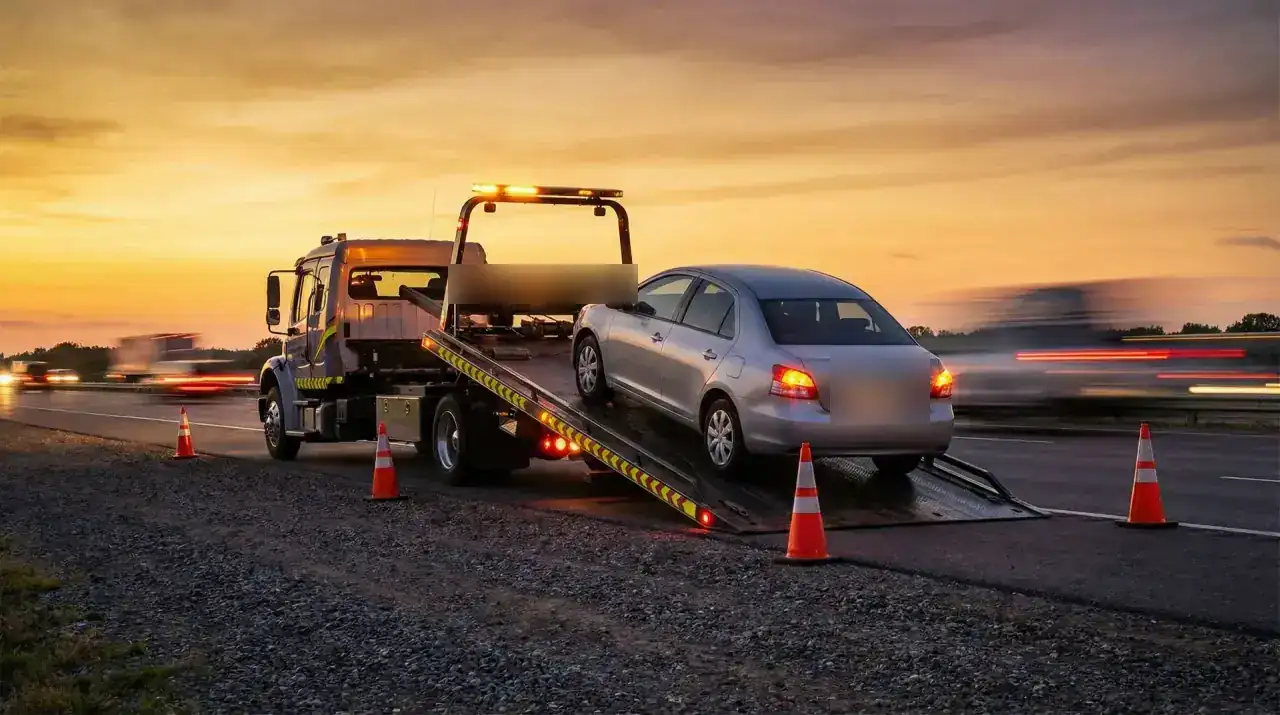
Most black-ice calls are not wrecks. They are cars sitting at an awkward angle on a shoulder, a lawn or a ditch bank that cannot drive out on their own. A winch-out pulls the car back onto pavement in a controlled way, and the driver takes a look before you pull away. If a tire came off the bead or went flat against the curb, our tire change service fits your spare, or we tow the car to a tire shop if the spare is not usable. We do not repair tires on the roadside.
If the car hit something hard, the steering wheel now sits crooked, or it pulls, shakes or makes new noises, do not drive it home. A bent wheel or suspension part can fail on the next bump. Our flatbed towing moves a damaged car with all four wheels off the road, and the emergency towing team handles freeway and late-night calls. If the car simply will not restart after sitting in the cold, roadside assistance can usually get it going where it is.
Timing and cost
Response times are estimates, never a guarantee, and icy roads slow every truck on them. In normal conditions most metro calls, including Worthington, are reached in 20–40 minutes and outer communities in 40–60. On the west and southwest side, including Grove City, it is usually 15–30 minutes.
Winch-outs are billed by the hour. A tow is a $125 hook-up plus $7 per loaded mile, with en-route at $4 per mile from our yard, and a tire change is a flat $75 plus en-route. Any surcharges are listed on our pricing page, veterans get 10% off with a military or veterans ID, and dispatch quotes the price before the truck rolls.
Frequently asked questions
What is black ice?
Black ice is a thin, clear layer of ice on the pavement. Because it is transparent, you see the dark road through it, so it looks like a wet road rather than ice. It usually forms when meltwater, drizzle, fog or dew freezes on a cold road surface.
Where does black ice form first around Columbus?
Bridges, overpasses and ramps usually ice over first, because elevated pavement loses heat from above and below. Shaded streets, low spots where water collects, intersections and parking lots are also common trouble spots, especially early in the morning after a sunny thaw.
What should I do if my car hits black ice?
Stay calm, hold the wheel steady and lift off the gas instead of slamming the brake. If the rear slides, look and steer gently toward where you want to go. If you have to brake and the car has anti-lock brakes, press firmly and hold steady pressure.
Should I call 911 or a tow truck after sliding on black ice?
Call 911 first if anyone is hurt, the car is in a live travel lane, or you are stranded in a storm and in danger. If everyone is safe and the car is just stuck off the road, call a tow company for a winch-out instead of trying to spin the tires free.
Can I drive my car after it slid into a curb or ditch?
Only if it looks and drives normally. A crooked steering wheel, a pull to one side, vibration, a flat tire or new noises can mean bent wheel or suspension parts, and the car should be towed to a shop rather than driven.
About this guide: it is general winter driving advice, not a driving course or a replacement for official weather and road alerts. Follow the directions of police, road crews and emergency officials.
Slid off on black ice somewhere around Columbus? Injuries or a car stopped in a travel lane mean 911 comes first. Otherwise, call (740) 812-9489 day or night, or send your location from the SOS request page.