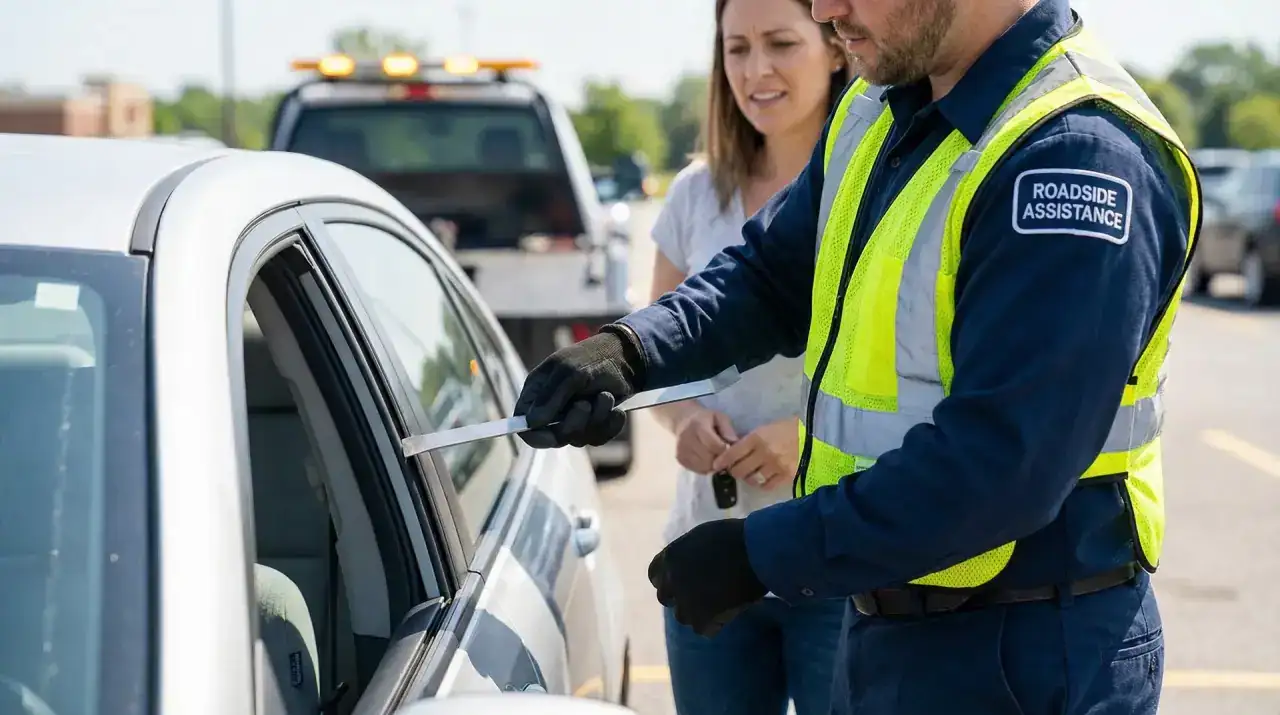
It is 7 a.m., you are already late, and the car door will not budge. Maybe the key will not turn in the lock, or the door unlocks with a chirp and still stays welded shut. After a night of freezing rain in Columbus, this is one of the most common ways a morning goes wrong, and the quick fixes people reach for, like a kettle of hot water or a hard yank on the handle, can turn a frozen door into a broken one.
This guide covers what actually works, what to avoid, and when to stop and call for help. If you are locked out and the lock will not cooperate, our lockout service gets you into the car without the key, around the clock across Central Ohio.
First: is anyone or anything locked inside?
Short answer: if a child or a pet is locked in the car, call 911 first, then call us. Cold is dangerous to a small child or an animal in a closed car, and emergency crews can act faster than any roadside company. The same goes for any winter-storm emergency where you or someone else is in danger.
If it is just you, the car and the ice, read on.
Why car doors and locks freeze
Two different things freeze, and they need different fixes.
- The door seal. Rain, sleet, slush or melted snow gets between the rubber weather stripping and the door frame, then freezes overnight. The lock works fine, but ice is holding the door closed.
- The lock itself. Moisture gets into the keyhole or the latch and freezes, so the key will not go in or will not turn, or the latch will not release when you pull the handle.
Freezing rain is the worst case, because it falls as rain and freezes on contact, coating every surface of the car in a shell of ice at once. Central Ohio gets its share of it, and a car parked outside in a driveway in Hilliard or an apartment lot in Reynoldsburg takes the full hit.
What not to do
Do not pour hot water on the car
AAA is blunt about this one: never pour hot or boiling water on a frozen car. Cold glass hit with hot water can crack, and a cracked window or windshield costs far more than a late start. Even if nothing cracks, the water runs into the seals, the lock and the door gaps, and on a cold morning it can freeze again before you get the door open, leaving you worse off than before.
Do not yank the handle
Door handles, especially on newer cars, are not built to be a pry bar. Pulling hard on a door that is frozen shut can snap the handle, tear the rubber seal or bend the trim. AAA warns against using excessive force to break the ice by yanking on car parts.
Do not force the key
A key that will not turn is telling you something. Forcing it can bend or snap the blade inside the lock. A broken key is no longer a frozen-lock problem; it is a locksmith or dealer problem, and that takes longer to sort out.
Do not chip at the ice with a metal tool
Scraping hard around the door edges with a screwdriver or a metal scraper scratches paint and can cut the seal. Save the ice scraper for the glass.
How to open a frozen car door
If the car unlocks but the door will not open, the seal is frozen. Try these in order:
- Push before you pull. AAA's advice is to push on the door with firm but gentle force, then pull. Leaning your weight into the door can crack the ice around the seal. It may take a few tries.
- Try every door. Another door may not be frozen as badly. If any door opens, get in, start the car and run the heat and defroster. A few minutes of warm cabin air often frees the stuck door from the inside.
- Use remote start if you have it. Letting the car warm up with the defrost running does the same job from outside. Never warm a car up inside a closed garage; exhaust in an enclosed space is a carbon monoxide hazard.
- Use a de-icer spray on the seal. A commercial de-icer sprayed along the gap where the door meets the frame helps loosen the ice. Give it a minute, then push and pull again.
- Clear the ice at the edges. Brush off the snow and break up ice sitting along the top of the door and in the handle recess, gently and with a plastic tool, so the door has room to move.
How to unfreeze a car door lock
If the key will not go in or will not turn, the lock is frozen. Most cars unlock with the fob, so try the fob first. If the fob does nothing, its battery may be weak; many fobs hide a mechanical key inside, and your owner's manual shows how to release it and where the hidden keyhole is.
- Lock de-icer. AAA recommends a commercial lock de-icer sprayed into the keyhole. It is cheap, small and worth keeping somewhere other than the car, such as a coat pocket or a desk drawer at work.
- Hand sanitizer or rubbing alcohol. AAA also suggests a drop or two of alcohol-based hand sanitizer or isopropyl alcohol on the key. Insert it and turn gently, a little at a time.
- Be careful with heat. Warming the key can help, but AAA warns that heating a key with a flame can damage keys with an electronic chip in the head, which many modern keys have. Lock de-icer is also flammable, so never combine it with an open flame.
If none of that works, stop. That is the point where a lockout call costs less than a broken key or a damaged lock.
Electric cars and flush door handles
Many EVs, Teslas in particular, use flush handles that pop out or pivot, and ice can lock them in place. Tesla's owner's manual notes that ice buildup can make the handles harder to open in severe winter weather, and that you can use the mobile app to open the driver door. The app's Defrost Car setting, or scheduled preconditioning, warms the car ahead of time to clear ice from the windows, mirrors and charge port. Check the cold-weather section of your own manual, because the steps vary by model.
If the car has no power at all, the manual says to connect low-voltage power before opening a door, to avoid breaking a window. That is often a dead low-voltage battery, not the big pack, and a jump start on the 12-volt system usually wakes it up. If an EV has to be moved, it travels with all four wheels off the ground, on a wheel-lift with dollies or a flatbed; our EV and Tesla towing page explains why.
How to keep doors and locks from freezing
- Treat the seals before the freeze. AAA suggests wiping the rubber seals dry and coating them with a light lubricant. Use a product labeled safe for rubber, such as a silicone spray applied with a cloth, so water beads off instead of sticking.
- Cover the keyhole. AAA's tip is a small magnet over the keyhole on nights when freezing rain is in the forecast.
- Park smart. A garage or a carport keeps freezing rain off the car.
- Close doors firmly. A door that is not fully latched lets water in around the seal.
- Keep the battery healthy. A weak battery and a frozen door often show up on the same morning. Our winter battery checklist covers the warning signs, and our winter car emergency kit list covers what to keep inside the car.
When to call for help
Call a roadside service when the key will not turn after de-icer, when the fob and the hidden key both fail, when the keys are locked inside the car (easy to do when you leave the car running to warm up), or when you simply cannot afford to break a handle on the way to work.
Our lockout service opens the car with professional entry tools, without the key. We unlock vehicles only: we do not cut, make or replace keys, so a lost key or a key broken off in the lock is a job for a locksmith or the dealer. If the car is open but will not start once you are inside, the same truck can handle a jump start, and our roadside assistance covers flat tires and fuel too.
Dispatch runs around the clock across Columbus and the surrounding communities, from Westerville to Hilliard and Reynoldsburg. Most metro calls are reached in 20–40 minutes and outer communities in 40–60; that is an estimate, and an ice storm can stretch it.
Lockouts and jump starts are a flat $75 plus en-route at $4 per mile from our yard, and veterans get 10% off with a military or VA ID. The full rate card lists the after-hours, weekend and highway surcharges, and dispatch gives you the price before the truck rolls.
Frequently asked questions
Can I pour hot water on a frozen car door?
No. AAA warns against pouring hot or boiling water on a frozen car, because the sudden temperature change can crack cold glass. Water also runs into the door seals and the lock, where it can freeze again. Use a lock de-icer, push on the door to break the ice, or let the car warm up instead.
How do I unfreeze a car door lock?
Spray a commercial lock de-icer into the keyhole, or put a drop of hand sanitizer or rubbing alcohol on the key, insert it and turn gently. AAA lists both. Do not force the key: a bent or broken key turns a five-minute problem into a locksmith visit.
Why won't my car door open when it is unlocked?
Ice has frozen the rubber seal to the door frame. AAA suggests pushing firmly but gently into the door, then pulling, which can crack the ice. If another door opens, get in, start the car and let the heat loosen the stuck one.
Can a roadside service open a car with a frozen lock?
Yes, if the problem is getting into a locked car. A lockout technician opens the door with professional entry tools instead of the key. Roadside Towing & Recovery Inc unlocks vehicles only; a broken, lost or dead key is a job for a locksmith or the dealer.
Frozen out of your car this winter? Call (740) 812-9489 or send your location from the SOS request page.