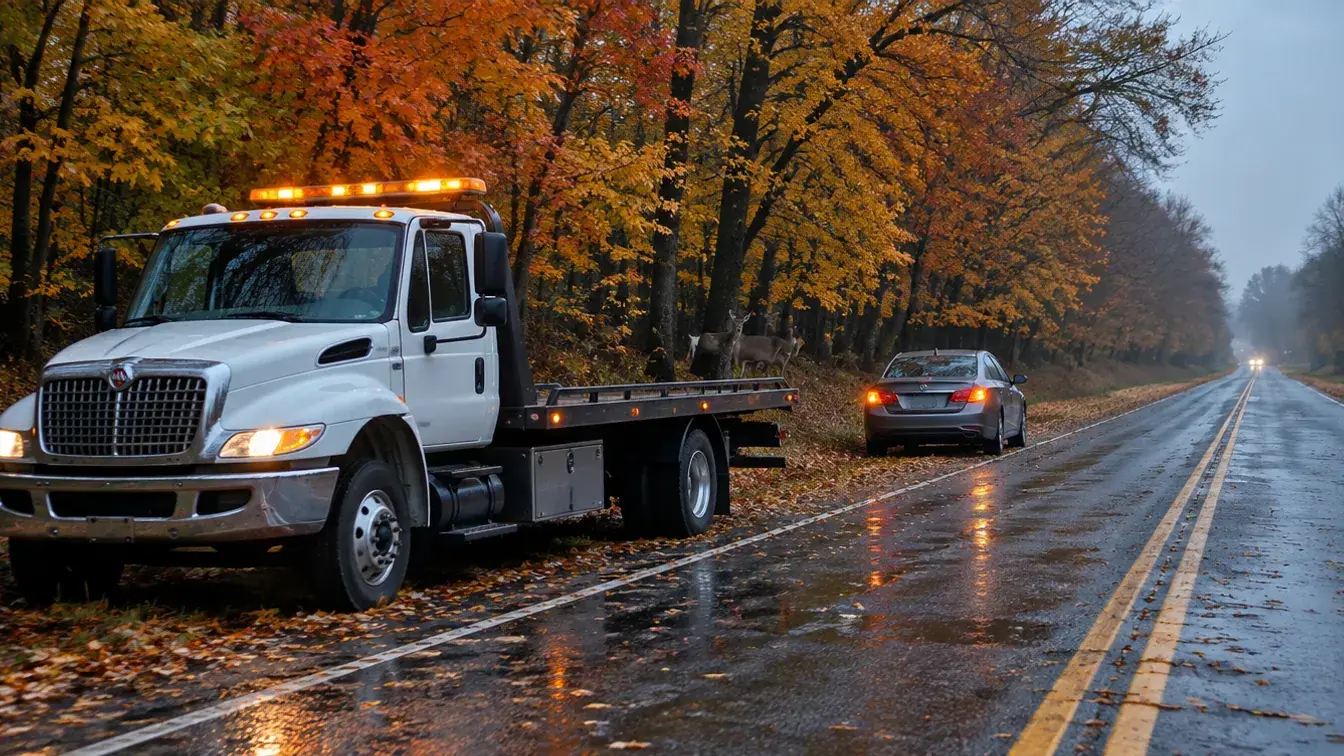
Mid-September in Columbus feels like a reward. The humidity breaks, Ohio State is back on the field, and the drive out US-33 toward Hocking Hills starts turning gold. But the six weeks between now and the first hard freeze are quietly one of the busiest stretches of the year for our dispatch line. The reasons are not dramatic. They are small, predictable, and almost entirely avoidable.
Here is what actually strands Central Ohio drivers in the fall, where it happens, and the twenty-minute checklist that keeps most of it from happening to you.
1. Deer season starts now, not in November
Ohio records roughly 20,000 deer-related crashes a year, and the curve climbs from October through December as the breeding season pushes deer across roads at dawn and dusk. The Ohio State Highway Patrol and the Ohio Department of Natural Resources both flag the same window every year, and Central Ohio is not exempt just because it is suburban.
The corridors where we pick up deer-strike vehicles most often are the ones that thread between woods and water: US-33 and SR-161 through Delaware and Licking counties, the northern arc of I-270 between Sawmill Road and Hamilton Road, Hoover Reservoir and Alum Creek, Sunbury Road, and the stretches of US-23 and SR-315 that run along the Olentangy. If your commute crosses any of those between 5 and 8 in the morning or 5 and 9 at night, treat the shoulders like they are moving.
- One deer means more deer. They travel in groups. If one crosses, slow down and expect a second.
- Brake, do not swerve. Most of the serious injuries we see from deer strikes come from a vehicle that swerved into a ditch, a tree, or oncoming traffic, not from the deer itself.
- After a strike, check the front end before you drive. A cracked radiator or a punctured intercooler can look fine at the scene and leave you steaming on the shoulder three miles later. If coolant is dripping or the hood will not latch, call for a tow rather than limping home.
2. Wet leaves are as slick as ice, and they hide the potholes
By mid-October the tree-lined roads in Bexley, Upper Arlington, Clintonville, and Worthington are carpeted. A layer of wet leaves on asphalt reduces tire grip about as much as light snow, and unlike snow, nobody plows it. Olentangy River Road, Riverside Drive, Dublin Road along the Scioto, and the residential grid around Schiller Park are where we see the fall spin-outs and the curb strikes that bend a tie rod or crack a wheel.
Leaves also fill the potholes that summer heat opened up, so a hole you would have steered around in August is invisible in October. If you hit one hard and the steering wheel is suddenly off-center or the car pulls, do not keep driving on it. A bent control arm or a separated tire bead can fail without warning at highway speed.
3. The first cold snap finds every weak battery in the city
Columbus usually sees its first frost in the second half of October. The morning after it arrives, our jump-start calls roughly double. Cold does not kill batteries, it exposes them. A battery that spent July cooking at 95 degrees has lost capacity it will never get back, and the first 35-degree morning is the first time it is asked to deliver full cranking power to cold, thick oil.
The tell is not a click. The tell is a slower crank than you remember, or headlights that dim when you start the car. If your battery is more than three years old and does either of those things, get it load-tested this month. It is a ten-minute test at any parts store or partner shop, and it is a lot cheaper than a 6 a.m. jump start in a Polaris parking garage.
4. Your tires lose a pound of pressure for every ten degrees
Air contracts as it cools. A tire set to 35 psi on a 90-degree afternoon in August will read closer to 30 psi on a 40-degree October morning, without a leak anywhere. That is enough to light the pressure warning on most cars, and more importantly it is enough to overheat the sidewall on a long run down I-71 to Cincinnati. Under-inflation is the single most common cause of the blowouts we respond to on the interstates, in every season.
Check pressures cold, first thing in the morning, against the sticker inside the driver's door, not the number on the tire. Do it once now and once again after the first freeze. While you are down there, look for cracking in the sidewall. Rubber that baked all summer tends to show it in the fall.
5. It gets dark at 5:30, and half the city's wipers are shot
Daylight saving time ends on November 1 this year. The evening commute on I-270, I-70, and SR-315 goes from daylight to full dark almost overnight, and it does so in the rainiest weeks of the fall. Wiper blades that squeaked through the summer smear the first cold rain into an unbroken sheet at 65 mph, and a headlight with a yellowed lens throws about half the light it did when it was new.
Replace the blades. Top off the washer fluid with a winter blend so it does not freeze in the lines. Turn the headlights on and walk around the car once; a burned-out low beam is the reason for a surprising number of the accident-scene recoveries we handle in November, because the other driver simply did not see the car until it was too late.
The twenty-minute fall checklist
- Battery: load test if it is over three years old or cranks slowly.
- Tires: set pressure cold to the door-sticker number; inspect sidewalls; check tread with a quarter (if Washington's head is fully visible, replace).
- Wipers and washer fluid: new blades, winter-rated fluid.
- Lights: all four corners plus brake lights; polish or replace clouded headlight lenses.
- Coolant: level at the cold line in the reservoir; a 50/50 mix protects to about 34 degrees below zero.
- Trunk kit: a blanket, a flashlight with fresh batteries, gloves, a phone charger, and a reflective triangle. Fall breakdowns happen in the dark and the cold far more often than summer ones.
If it happens anyway
Get as far off the road as the car will go, hazards on, and stay belted in the vehicle if you are on a highway shoulder. Then call us at (740) 812-9489 or use the SOS request page, which sends us your GPS location so you do not have to guess at a mile marker in the dark. Jump starts, tire changes, lockouts, and fuel delivery are flat-rate services, and if the car needs more than a roadside fix we can tow it straight to one of our partner repair shops. Dispatch runs 24 hours a day, every day of the fall, including Buckeye game nights.